
Dragon Blood Tree Dracaena cinnabari
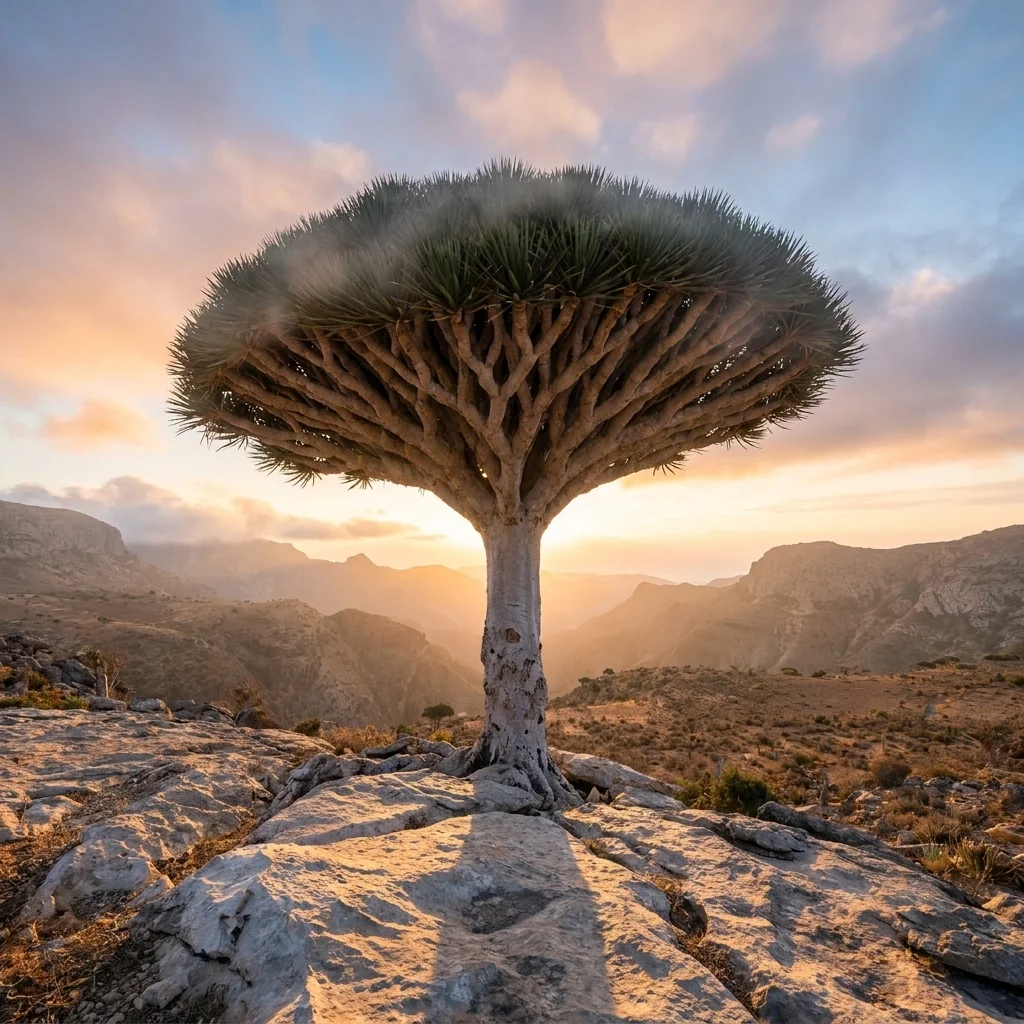
The most iconic species on Socotra and arguably the most photographed tree on Earth. Its dense umbrella canopy, shaped over centuries by monsoon winds, distinguishes it from every other plant in the world. When the bark is cut, it weeps a deep crimson resin that has been traded as medicine, dye, and incense since antiquity.
The trees are slow-growing and long-lived, many exceeding 300 years. They reproduce only when mist provides sufficient moisture for germination: a mechanism that is now under threat. Rising temperatures and declining cloud cover on the Hagher Mountains have reduced seedling regeneration to near zero in some areas. The adult population is stable; the next generation is not.
Diksam Plateau holds the densest accessible stand. Homhil Protected Area offers a smaller but equally dramatic grove with a highland viewpoint above the forest. The approach path to Hoq Cave passes through scattered individuals in rocky terrain. Photographically, the trees are most dramatic at sunrise when mist softens the canopy silhouettes and low light rakes across the pale limestone.
Where to see it
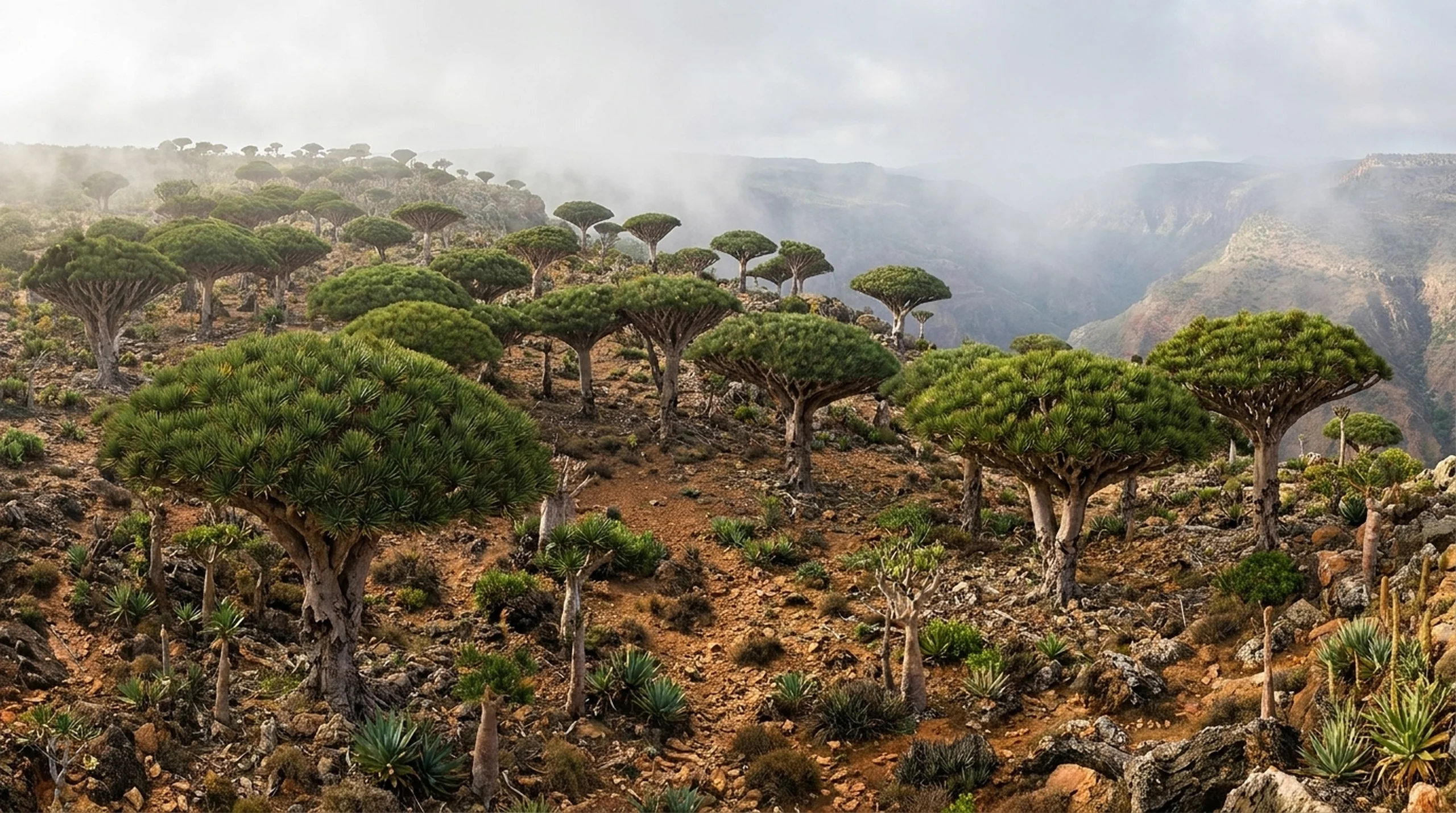
Diksam Plateau
forestLargest accessible stand on the island; most photogenic at sunrise
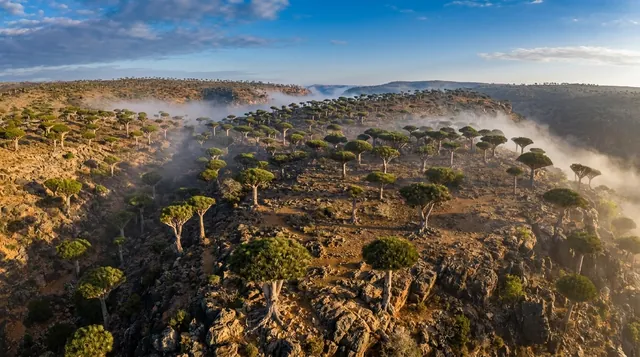
Firmihin Forest
forestPrimary location: largest accessible dragon blood tree forest on Earth; 550 ha and 35,500+ individual trees
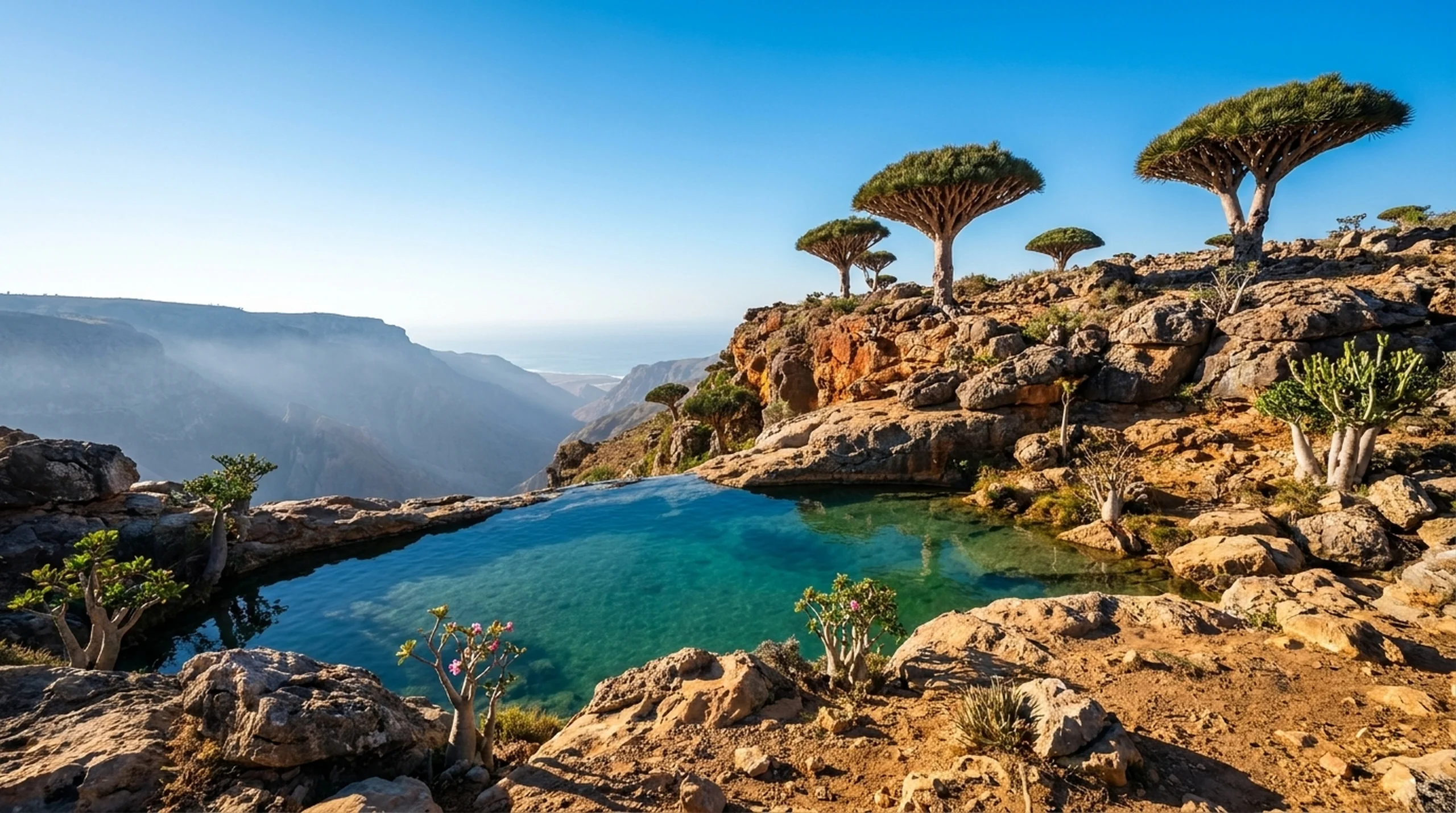
Homhil Protected Area
forestSmaller grove with highland viewpoint; accessible via the infinity pool hike
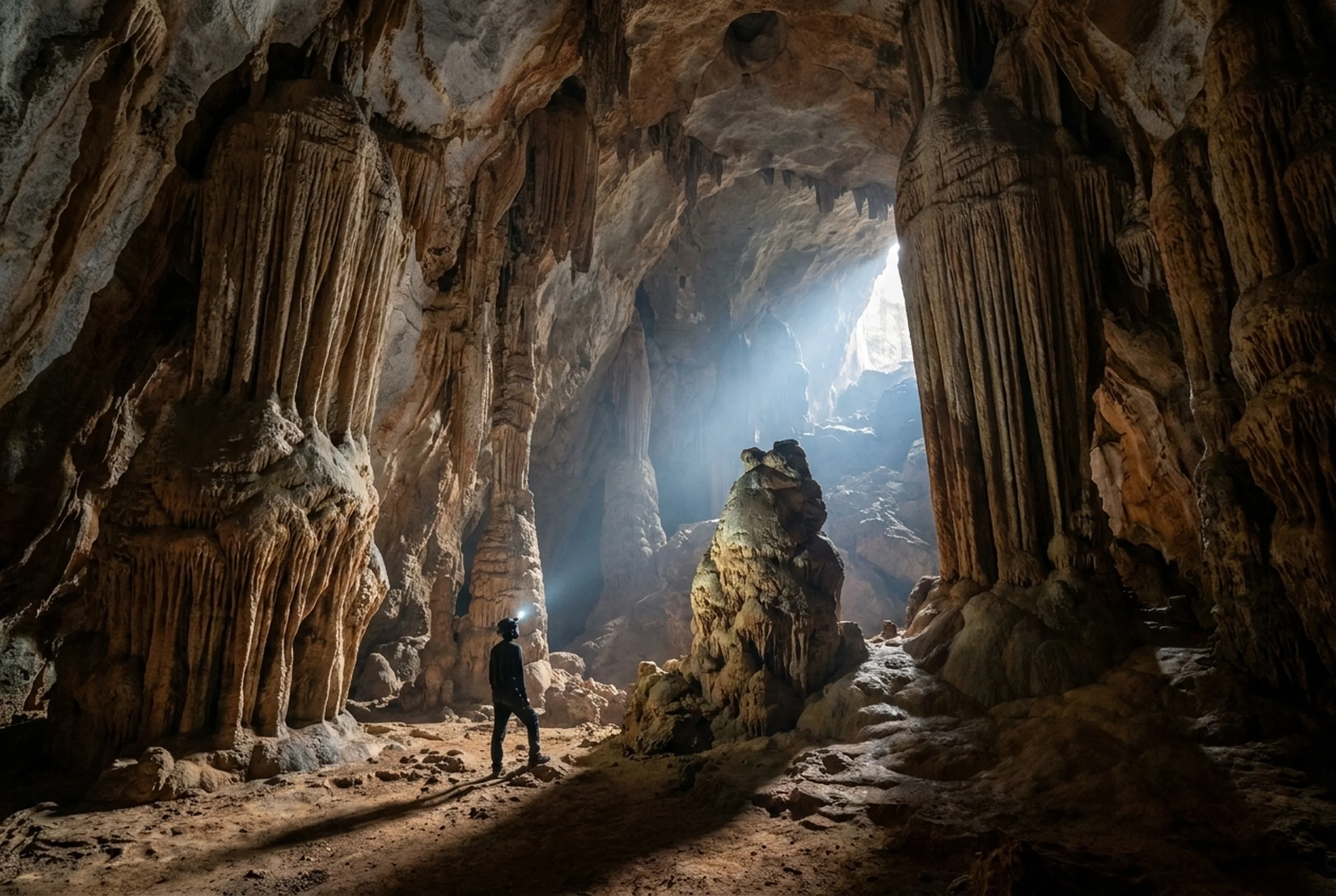
Hoq Cave
caveScattered individuals on the rocky approach path to the cave

Skand Peak
mountainDragon Blood Trees on upper rocky slopes; encountered on the summit approach from Tarhar
Planning a trip?
Photographing it
Sunrise or sunset when mist softens canopy silhouettes and low light rakes the pale limestone. Wide-angle (16-35mm) for environmental perspective showing canopy scale against sky; telephoto (200-400mm) for compression shots stacking multiple canopies. A human figure for scale reveals how tall a mature grove really is. Overcast light works well for the silvery bark texture. Shoot through gaps in the canopy from below for graphic negative space. Diksam Plateau offers the densest accessible stands; arrive before sunrise for mist conditions.
Worth knowing
The crimson resin has been harvested and traded for over 2,000 years: the Romans called it sanguis draconis (dragon's blood) and used it as medicine, varnish, dye, and incense. Ancient trade routes crossed the Red Sea specifically for it. The resin still commands premium prices in traditional medicine markets today.
Conservation status
Vulnerable (IUCN). Adult population stable across Socotra but seedling regeneration has collapsed in key highland zones: rising temperatures and declining mist frequency on the Hagher Mountains prevent germination. The tree's slow growth means the generational failure may not be visible for decades. Listed as a World Heritage Site species; no species-specific conservation program beyond the UNESCO umbrella.
Where to see them, and which forest suits what
Five places are linked to the tree in our database, and they are not interchangeable.
| Place | What it is for |
|---|---|
| Firmihin Forest | The trees as a landscape. Road access through the plateau, low wind, drones permitted, sunrise. |
| Diksam Plateau | The stop most itineraries already include, and the grove where Socotra starlings nest in the branches. |
| Homhil Protected Area | One walk, three marquee endemics: dragon blood, bottle tree and cucumber tree. No drones. |
| Hoq Cave | Scattered individuals on the rocky climb, if the cave is already on your plan. |
| Skand Peak | Trees on the upper slopes of a six hour mountain day. |
What the forest is like on foot is the long read: a field guide to Dracaena.
Are they dying?
The old trees are still standing in large numbers. The problem is that almost nothing replaces them as they die.
Dracaena cinnabari is Vulnerable on the IUCN Red List, from a global assessment dated 2004 that the Red List itself flags as needing an update.
A field survey of Firmihin estimated, on its central age model, that about 85 stems in 100 carry a crown of 100 to 400 years, about 3 in 100 one above 400, and about 12 in 100 fall in the youngest class, which also holds stems with no crown. On the paper's other two models the share above 400 years runs from about 1 to 23 in 100. In the authors' words, the population is overmature, an evident consequence of missing regeneration.
Two explanations have been proposed for the missing young trees, grazing and a drier climate. Both field studies cited here favour grazing. The same team has reported seeds germinating at 84.6% at 26 degrees Celsius under controlled conditions, which they read as a sign the seeds can regenerate. Cyclones are a further pressure: the 2023 study lost monitoring plots to landslides in 2015 and 2018.
A 2007 model, under one climate scenario, projected that the area suitable for the tree would shrink by 45% by 2080. The same study found the species occupying about 5% of its potential habitat and rated only two of nine remnant stands as refuges.
How old they get, and why the crown has that shape
The tree is a monocot and lays down no annual rings, so every age you read is a model estimate. The famous figure of thousands of years was an old estimate for a different species, the Canary Island dragon tree on Tenerife.
The most direct estimate re-measured 1,077 trees at Firmihin in 2021 against the same trees ten years earlier and turned the ten year stem increment into an age model. Its central estimate puts a trunk 10 to 15 cm across at breast height at about 111 years, and one of 90 to 95 cm at about 672 years. The model is rough: it explains about 5% of the variation in the data, and the 95% range for the largest trees runs from 447 to 1,911 years.
The crown explains itself once you know how it is built. A trunk grows unbranched until the tree first flowers, which can take centuries: estimates for trees still carrying a single leaf rosette run from 209 to 549 years. Each flowering closes a branch section and splits it, so the crown accumulates as a stack of sausage shaped segments. An early estimate put 13.7 to 29.6 years between flowerings, 18.7 on average; later work found the gaps shorten as the tree ages, from about 28 years to about 10. A dense umbrella over a bare trunk is what that arithmetic looks like after several hundred years.
What the resin is
Dragon's blood is a deep red resin that oozes from cuts in the stem. On Socotra the tree is ahrieb, the resin dum al-akhawin, and the cooked product eda'a. It is still a traded export.
Chemically it is a flavonoid resin: named constituents include the biflavonoid cinnabarone, triflavonoids, chalcones, dihydrochalcones, sterols and terpenoids. Documented traditional uses run to wounds, fractures, ulcers, dysentery and diarrhoea, and it has also served as an artists' pigment. A 2021 review collects laboratory studies reporting antimicrobial and anti-inflammatory activity for this resin, with wound healing results mostly from related species. That is bench evidence, not clinical proof, and not medical advice.
Harvesting leaves a mark. Centuries of tapping left the wounds visible on old trunks, and unsustainable harvesting is listed beside overgrazing and climate change among today's pressures.
The rules among the trees
Stay on the path your guide uses. The seedlings the population needs are small and sparse, and an open limestone floor gives no cue that you are standing on one. Do not cut, carve or tap a trunk for resin: it leaves a scar that stays visible.
The archipelago has been a UNESCO Biosphere Reserve since 2003, and the grove you are in may sit inside a named protected area with its own rules. Homhil is one, and drone flight is not part of a Homhil visit. Where drones are allowed, which includes Firmihin and Diksam, they need a permit costing $100 in cash on arrival; the detail is in the drone guide. A 2007 study described a strictly protected sanctuary at Skund where road infrastructure is not allowed, and argued for widening it.
Camping among the trees at Firmihin is normal, and your operator arranges it.
Common questions
How old are Socotra's dragon blood trees?+
Are the dragon blood trees on Socotra dying?+
Where is the best place to see dragon blood trees on Socotra?+
What is dragon's blood resin used for?+
Sources
Checked on 6 November 2026
IUCN Red List of Threatened Species: Dracaena cinnabari, assessment e.T30428A9548491. Vulnerable B2ab(iii), criteria version 3.1, assessed 30 April 2004, flagged by IUCN as needing an update. DOI 10.2305/IUCN.UK.2004.RLTS.T30428A9548491.en.
Supports: Vulnerable, from a global assessment dated 2004 that IUCN flags as needing an update.
The Red List page sits behind a browser check for automated readers; it was read in a browser during the fact check. Botanic Gardens Conservation International's ThreatSearch records the same category and year.
IUCN Red ListRead 6 November 2026
Adolt, R., Maděra, P., Abraham, J., Čupa, P., Svátek, M., Matula, R., Šebesta, J., Čermák, M., Volařík, D., Koutecký, T., Rejžek, M., Šenfeldr, M., Veska, J., Habrová, H., Čermák, Z., Němec, P. (2013). Field survey of Dracaena cinnabari populations in Firmihin, Socotra Island: methodology and preliminary results. Journal of Landscape Ecology 6(3). DOI 10.2478/jlecol-2014-0001.
Supports: The Firmihin age structure on the central age model (about 85 stems in 100 with a crown of 100 to 400 years, about 3 in 100 above 400, about 12 in 100 in the youngest class), the range of 1 to 23 in 100 above 400 years across its other two models, the finding that the population is overmature through missing regeneration, and the authors' view that pastoralism rather than climate explains it.
Preliminary estimates with wide confidence intervals, and the paper's three age models disagree most about the oldest class.
Journal of Landscape EcologyRead 6 November 2026
Bauerová, L., Maděra, P., Šenfeldr, M., Habrová, H. (2023). Age estimation of Dracaena cinnabari Balf. f. on Socotra Island: a direct method to determine its lifespan. Forests 14(4), 840. DOI 10.3390/f14040840.
Supports: No annual rings, so age can only be estimated; the thousands-of-years figure as an old estimate for D. draco on Tenerife; 1,077 trees re-measured at Firmihin in 2021; central estimates of about 111 years at 10 to 15 cm and about 672 years at 90 to 95 cm, with a 95% range of 447 to 1,911 years and a model explaining 5% of the variation; 209 to 549 years before first flowering; the early 13.7 to 29.6 year flowering interval and the later finding that it falls from about 28 to about 10 years; the team's 84.6% germination result at 26 degrees Celsius; plots lost to cyclone landslides in 2015 and 2018; overgrazing as the most likely cause of low regeneration; wounds that heal over but stay visible.
ForestsRead 6 November 2026
Attorre, F., Francesconi, F., Taleb, N., Scholte, P., Saed, A., Alfò, M., Bruno, F. (2007). Will dragonblood survive the next period of climate change? Current and future potential distribution of Dracaena cinnabari (Socotra, Yemen). Biological Conservation 138(3 to 4), 430 to 439. DOI 10.1016/j.biocon.2007.05.009.
Supports: About 5% of potential habitat occupied; under one 2080 climate scenario, a 45% reduction of the potential habitat through increased aridity; two of nine remnant areas rated as refugia; and the strictly protected Skund Nature Sanctuary, where road infrastructure is not allowed, as described in 2007 with a recommendation to extend it.
We read the abstract in the publisher's institutional repository; the full article is paywalled. The projection is one climate scenario, not a measurement.
Wageningen University and ResearchRead 6 November 2026
Al-Awthan, Y. S., Bahattab, O. S. (2021). Phytochemistry and pharmacological activities of Dracaena cinnabari resin. BioMed Research International 2021, 8561696. DOI 10.1155/2021/8561696.
Supports: The resin as a red exudate that oozes from cut stems, the local name dum al-akhawin, the named constituents, the documented traditional uses, the use as a pigment, the laboratory activities reported for it, and that the animal wound healing studies it cites mostly used a related species, D. cochinchinensis.
A review of laboratory and animal studies. It is not evidence of clinical effect in people.
PubMed CentralRead 6 November 2026
Al-Okaishi, A. (2021). Exploring the historical distribution of Dracaena cinnabari using ethnobotanical knowledge on Socotra Island, Yemen. Journal of Ethnobiology and Ethnomedicine 17(1), 22. DOI 10.1186/s13002-021-00452-1.
Supports: The Socotri names ahrieb, dum al-akhawin and eda'a; centuries of resin harvesting leaving wounds on the trees; and unsustainable harvesting listed with overgrazing and climate change among today's pressures.
PubMed CentralRead 6 November 2026