
Nature
The Dragon Blood Tree: A Field Guide to Dracaena
Where to find them, when the light works, and why the biggest forest on Earth is a population with almost nothing growing underneath it.
9 min read
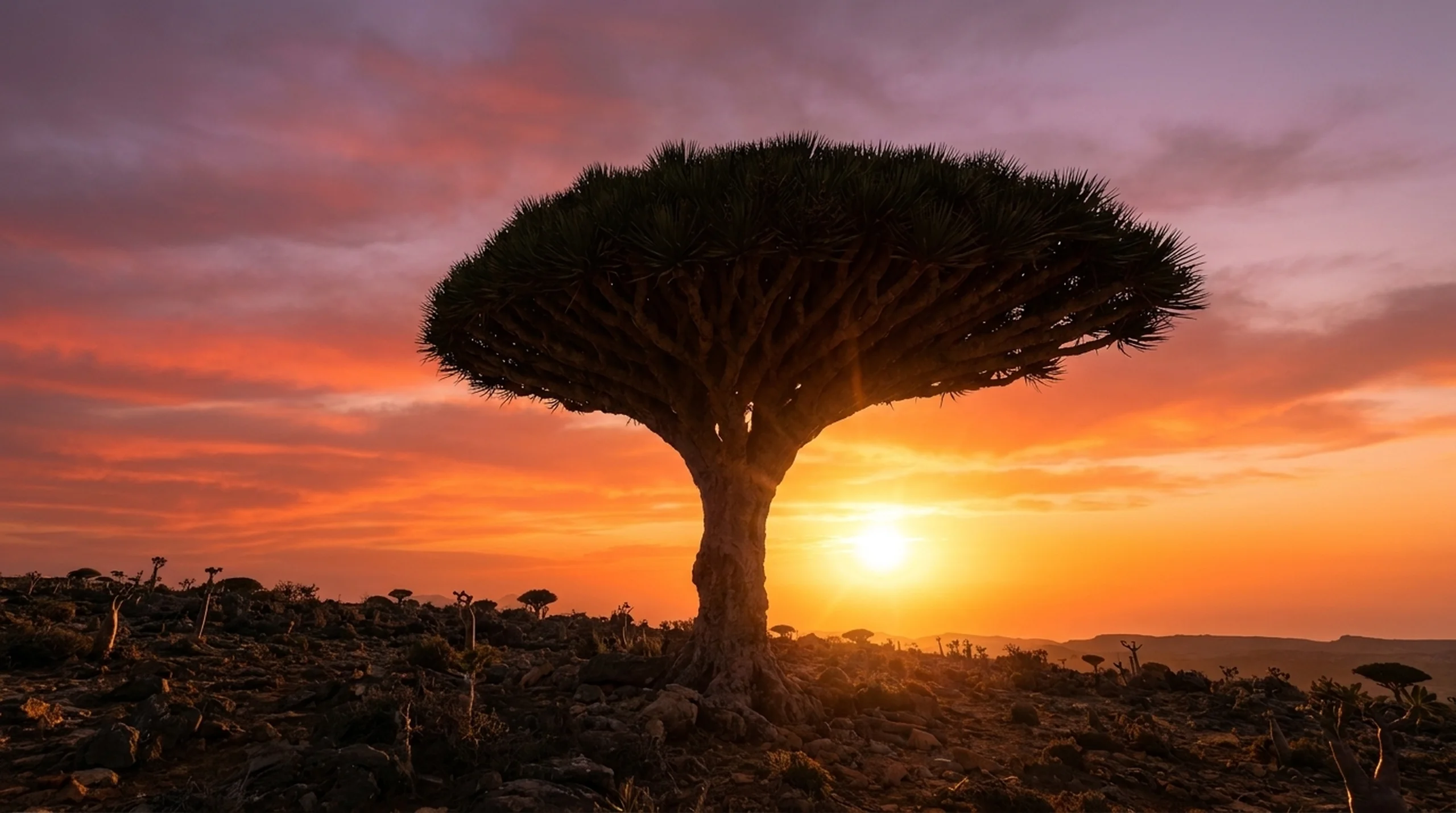
Firmihin Forest covers about 550 hectares and holds more than 35,500 dragon blood trees. It is the largest stand of them on Earth, and you can drive to it. That combination, a globally unique forest with a road to the edge of it, is the reason Socotra sits on so many photographers' lists.
It is also the reason the tree is written about so badly. Search for it and you get two kinds of page: botanical reference that tells you the family and the leaf arrangement and nothing about standing in front of one, or operator listings that reproduce the same three sentences about an alien umbrella. What is missing is the part that helps you: where the trees are, what the light does, what the forest is doing ecologically, and what is going wrong with it.
What you are looking at
The dragon blood tree is Dracaena cinnabari, and the shape is the thing everyone photographs. A single trunk rises and then divides, and divides again, until the crown flattens out into a dense upturned bowl of branches. From a distance a grove reads as a field of mushrooms, or umbrellas, or something built rather than grown.
A note on what this page will not do. Much of what circulates online about this tree, its precise age, its growth rate, the biomechanics of that crown, comes from sources outside the research this guide is built on. Rather than repeat figures we cannot stand behind, we have left them out. The tree is remarkable enough without them, and a number you cannot source is worse than no number at all.
What we can tell you is where they grow and what they do for the rest of the island.
The bird that lives inside it
This is the fact worth carrying away, and almost nobody writes it.
The Socotra starling, Onychognathus frater, is a robust glossy black bird of about 25 centimetres, iridescent purple-blue in the right light, with rufous-chestnut primary feathers that flash orange-red when it opens its wings. It nests exclusively in the hollow branches of dragon blood trees. It feeds on their berries. It disperses their seeds.
That is a dependency running in both directions. The bird has no other nest site, which makes it one of very few bird species anywhere tied to a single tree species for somewhere to breed. The tree relies on that same bird to move its seed. The consequence is stated plainly in the research: where dragon blood tree regeneration fails, the starling eventually follows.
The starling itself is currently Least Concern, assessed in 2024, with a stable population running around 7 birds per square kilometre in suitable habitat. The threat flagged against it is not hunting or direct habitat loss. It is the long-term, climate-driven decline in dragon blood tree regeneration. A stable bird with an unstable foundation.
If you want the wider picture of what else lives here, that is in the Socotra wildlife guide. The tree's place among the island's other endemics is covered in the guide to Socotra's plants.
Where to find them
Firmihin Forest is the headline. About 550 hectares, more than 35,500 individual trees, rolling limestone with a sparse understorey and canopies closed overhead. It is reached by road via Diksam, it is in the plateau interior so it is partially sheltered and wind sensitivity is low, and drone flight is permitted. Sunrise is the recommended window.
Diksam Plateau sits at roughly 700 to 900 metres and holds one of the densest accessible concentrations on the island. It is the stop most itineraries include, and it is also the most reliable place to find starlings in the groves, because the nesting association is strongest there.
Homhil Protected Area is the efficient one. Large dragon blood specimens grow there alongside bottle trees and cucumber trees on the same trekking path, so a single walk gets you three of the island's marquee endemics. If your schedule only allows one botanical day, this is the strongest single walk.
There are also accessible stands inland from Mouri Beach on the north coast near the airport, roughly a 10 to 15 minute walk from the shore. That matters more than it sounds: it is the one place you can put dragon blood trees and coastline into the same day without committing to a mountain drive, which makes it a sensible first or last session.
The island's other essential stops are listed on best places, which is the fastest way to see how a dragon blood day fits around everything else.
What it is like to be in the forest
Photographs of Firmihin flatten it, because a canopy shot from below or a drone frame from above both remove the thing you notice first on foot, which is how open it is underneath.
The understorey is sparse. You walk on limestone between trunks with clear sightlines in most directions, and the canopies close over you rather than around you. That is why the forest photographs as texture from the air and as architecture from the ground, and why the two images look like different places. It is also, on reflection, the visual signature of the problem described further down: an open floor is a floor with very little young growth on it.
The ground is rock. Footing is uneven limestone rather than soil, so this is closed-toe footwear terrain, and it rewards moving slowly. Sound carries: the starling flocks are usually audible before they are visible, which is the practical reason to stop walking and listen if you want to find them rather than stumble into them.
Elevation shapes what grows where. Diksam sits at roughly 700 to 900 metres, and the upper slopes of the Hagher Mountains hold a moister assemblage again. You can cross several distinct plant communities in one driving day on Socotra, which is part of why the island rewards a longer trip than most people book.
A note on behaviour among the trees, because the forest is more fragile than it looks. Stay on the paths your guide uses rather than cutting between trunks. The seedlings that matter are small, sparse and easy to tread on without registering it, and an open limestone floor gives you no visual cue that you are standing on the one thing the forest needs. Do not carve, cut, or tap a trunk for resin. Both points hold everywhere on Socotra, and they hold hardest in the one place where the replacement generation is already the limiting factor.
Photographing them
The trees are static, shot to death, and easy to render badly. Three things separate a good frame from the thousandth identical one.
Go at dawn, and go to Firmihin. Sunrise is the recommended time there, and the reason is wind as much as light: the plateau interior is partially sheltered, so early morning is when the air is calmest. That matters for drone work and it matters for any long exposure.
Shoot the forest, not the specimen. The most common Socotra image on the internet is a single dragon blood tree, wide angle, warm magic-hour light. The research on the competitive landscape is blunt about this: that shot is extremely common. What is uncommon is close botanical work, endemic bird portraits, and night sky with trees. Firmihin at 35,500 trees is one of the few places on Earth where you can compose the canopy as a repeating texture rather than a hero object.
Bring a long lens for the birds. A 200 to 400mm handles perched starling portraits, and 400 to 600mm gets flight shots with the rufous wing panel open. That iridescent sheen only appears in direct or angled sunlight. Under flat overcast the bird photographs as a flat black silhouette, so if the morning is grey, shoot the trees and wait.
The uncommon frame is the night one. The analysis behind this site of what already exists online is specific about where the competition thins out: wide-angle trees at magic hour are everywhere, drone shots of turquoise lagoons are the second most common image from the island, and night sky with dragon blood trees is not. Socotra has exceptional dark skies, the groves are static subjects that hold a composition for a long exposure, and the low wind at Firmihin at the top and bottom of the day is what makes that technically possible. If you want a photograph from this island that does not already exist in ten thousand near-identical copies, that is where it is. The approach is covered in astrophotography on Socotra, and more on gear and conditions is in the photo guide.
One practical warning about the middle of the day. Overhead sun on a flat-topped canopy is the worst light this subject gets: the crown shades its own trunk, the ground goes bright, and the shape that made you come stops reading. Most itineraries pass Diksam in the middle of the day because of driving distances. If your schedule does that, treat it as a scouting pass and negotiate to return at dawn rather than shooting it at noon and considering it done.
When to go
October to April, and that is not really a preference. The khareef monsoon takes the island from roughly May to September, when sustained winds make camping impossible and most operators close. The flight schedule tracks the same window.
Inside that window there is one timing detail specific to this tree. The berries ripen in the late dry season, roughly March to May, and starling flocks concentrate in the groves to feed. Nesting activity in the dragon blood groves peaks over the same March to May stretch. If you want the forest at its most alive rather than at its most sculptural, that is the window, and it overlaps neatly with the bottle tree bloom in February and March.
Full month by month reasoning is in best time to visit.
The part the photographs do not show
Stand in Firmihin and you are looking at something closer to a monument than a forest.
The trees are mature. Regeneration is failing, and the research attributes that decline to climate. Layered on top is grazing: livestock browse seedlings before they reach maturity, which is the same pressure documented across the island's other endemic trees. The outcome is a population made almost entirely of adults with nothing replacing them.
This is the specific reason the standard photograph is misleading. A grove of thousands of established trees looks like abundance. Ecologically it is closer to an inventory of what already exists, with the replacement generation missing. A forest is not just its standing trees; it is the seedlings underneath them, and that is the layer that is not there.
The starling makes the stakes concrete. A bird that nests in nothing else is downstream of every seedling that does not make it. The tree's decline is not only a loss of a silhouette, it is the slow removal of an entire nesting habitat for a species with no alternative.
Socotra's UNESCO World Heritage listing provides umbrella protection, and for most species here that is close to the whole strategy. The parallel case is the island's frankincense, where the conservation picture is documented in far more detail and the trajectory is worse. The species-level records for both, along with every other endemic on the island, are in the species database.
What to take away
Go to Firmihin at dawn. Take the long lens as well as the wide one, because the bird in the branches is the more interesting subject and almost nobody photographs it. Go in March or April if you want the groves busy with starlings and the bottle trees flowering at the same time.
And look down while you are there. The trees are the reason you came, and the ground underneath them is the reason the place needs attention. Whether anything is growing up beneath that canopy is the question the postcard never answers.
When you are ready to plan the trip, talk to a licensed operator.