socotra.guide

Flora & fauna

Endemic species
of Socotra.

Socotra has been isolated for 20 million years. About a third of its plants and most of its reptiles and land snails exist nowhere else. Here's what you'll meet, how to identify it, and how to photograph it.

Cucumber Tree
Endemictree

Cucumber Tree

Dendrosicyos socotranus

The only tree-forming member of the cucumber family (Cucurbitaceae) on Earth — a fact that makes it one of the more improbable plants in existence. Elsewhere in the world, cucumbers, melons, and squashes grow as vines or ground-level plants. On Socotra, one member of the family evolved into a swollen-trunked tree reaching 5–6 metres, with a pale bloated trunk that stores water through the dry season. The trunk is the defining feature: smooth, pale grey, and almost comically wide relative to the sparse canopy above. Locals call it the bottle tree, though that name is also applied to Adenium obesum socotranum (a separate species). The easiest way to distinguish them: Dendrosicyos has a distinctly cucumber-like leaf shape and small yellow flowers; Adenium produces striking pink flowers directly from bare branches. Found on rocky hillsides and wadi walls across the limestone plateau zones. Hoq Cave's approach path has several specimens. Wadi Klisen Canyon walls support small populations growing directly from cliff cracks.

Conservation

Vulnerable (IUCN)

Fun fact

Every other member of the cucumber and squash family (Cucurbitaceae) on Earth grows as a vine, creeper, or ground-level plant. Socotra's 20 million years of isolation produced the sole exception — a full-sized tree. There is no other tree in the cucumber family anywhere on the planet.

Photography tips

Shoot from low and close to the base with a wide-angle (16-24mm) lens to emphasize the swollen pale trunk against sky or canyon walls. Hoq Cave approach has specimens growing from rock crevices — frame with the stone texture for graphic contrast. The sparse canopy means little shade; late afternoon side light reveals bark detail. Include a person for scale — the trunk width surprises most visitors. Do not confuse with Socotra Bottle Tree (Adenium): the Cucumber Tree has distinctly cucumber-shaped leaves and small yellow flowers, not the Adenium's vivid pink blooms.
Submit a photo of Cucumber Tree
Dragon Blood Tree
Endemictree

Dragon Blood Tree

Dracaena cinnabari

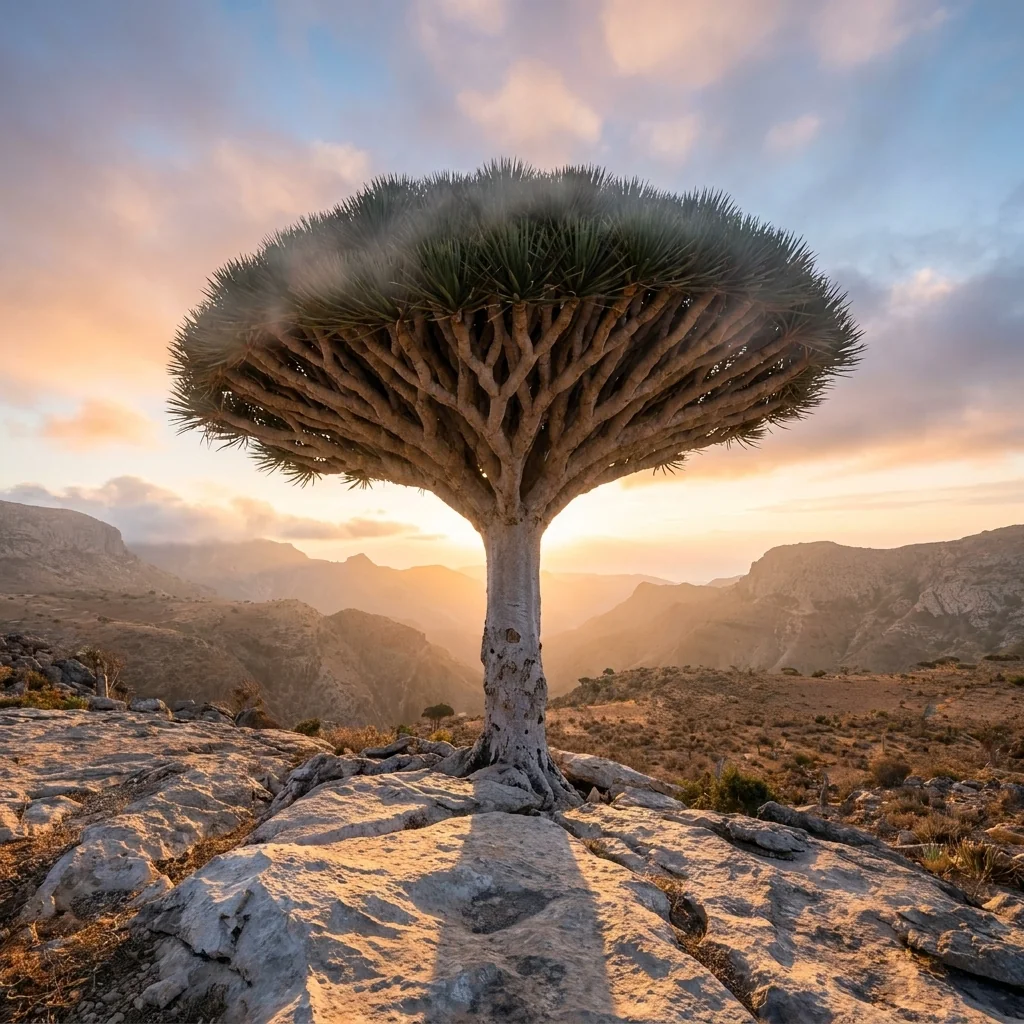
The most iconic species on Socotra and arguably the most photographed tree on Earth. Its dense umbrella canopy — shaped over centuries by monsoon winds — distinguishes it from every other plant in the world. When the bark is cut, it weeps a deep crimson resin that has been traded as medicine, dye, and incense since antiquity. The trees are slow-growing and long-lived, many exceeding 300 years. They reproduce only when mist provides sufficient moisture for germination — a mechanism that is now under threat. Rising temperatures and declining cloud cover on the Hagher Mountains have reduced seedling regeneration to near zero in some areas. The adult population is stable; the next generation is not. Diksam Plateau holds the densest accessible stand. Homhil Protected Area offers a smaller but equally dramatic grove with a highland viewpoint above the forest. The approach path to Hoq Cave passes through scattered individuals in rocky terrain. Photographically, the trees are most dramatic at sunrise when mist softens the canopy silhouettes and low light rakes across the pale limestone.

Conservation

Vulnerable (IUCN)

Fun fact

The crimson resin has been harvested and traded for over 2,000 years — the Romans called it sanguis draconis (dragon's blood) and used it as medicine, varnish, dye, and incense. Ancient trade routes crossed the Red Sea specifically for it. The resin still commands premium prices in traditional medicine markets today.

Photography tips

Sunrise or sunset when mist softens canopy silhouettes and low light rakes the pale limestone. Wide-angle (16-35mm) for environmental perspective showing canopy scale against sky; telephoto (200-400mm) for compression shots stacking multiple canopies. A human figure for scale reveals how tall a mature grove really is. Overcast light works well for the silvery bark texture. Shoot through gaps in the canopy from below for graphic negative space. Diksam Plateau offers the densest accessible stands; arrive before sunrise for mist conditions.

Submit a photo of Dragon Blood Tree
Egyptian Vulture
bird

Egyptian Vulture

Neophron percnopterus

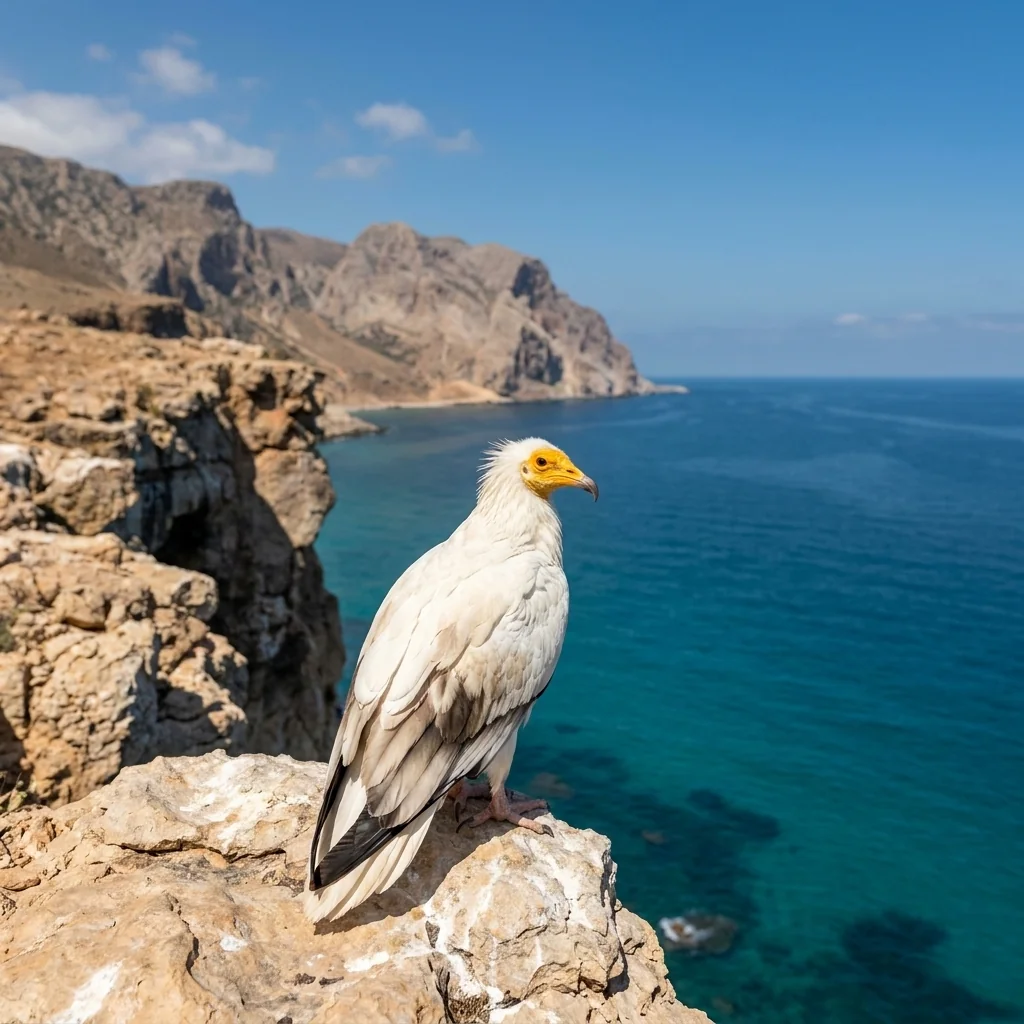
Socotra supports the highest recorded density of Egyptian Vultures anywhere in the world — an extraordinary concentration of a species that is Endangered across its range in Europe, Africa, and South Asia. The island functions as a refuge: stable year-round food sources (fish offal from fishing villages, carrion), minimal human persecution, and abundant nesting cliffs create near-ideal conditions. Adults are immediately recognisable: white plumage, bare yellow facial skin, and a wedge-shaped tail. Juveniles are brown, darkening progressively through a 5-year maturation period. They are highly intelligent, one of the few bird species documented using tools — dropping stones onto eggs to crack them. Found across the entire island but most reliably spotted near coastal cliffs, fishing harbours (Hadibo, Qalansiyah), and elevated rocky areas (Arher cliffs, Hoq Cave approach). They are not shy of humans and will approach camps when food scraps are present. Shoab Beach, accessed by boat, often has individuals working the cliff faces above the landing point.

Conservation

Endangered (IUCN) globally

Fun fact

One of the very few bird species documented using tools: Egyptian Vultures drop stones onto large eggs — like ostrich eggs — to crack them open. This behaviour was first filmed in the wild in the 1960s and remains one of the clearest examples of tool use by a non-primate animal.

Photography tips

Most accessible near Hadibo fishing harbour, where individuals work morning fish offal — tolerates very close approach from the dock. For flight shots: Arher Beach cliffs and Hoq Cave headland produce soaring individuals on morning thermals; 500-600mm captures spread primary feathers clearly. The wedge-shaped tail is the diagnostic field mark in flight. White adult plumage is very bright in midday sun — expose -1 stop or shoot in soft overcast for feather texture detail. Juveniles are all-brown; photograph any large soaring raptor and check later.

Submit a photo of Egyptian Vulture
Socotra Bottle Tree
Endemictree

Socotra Bottle Tree

Adenium obesum subsp. socotranum

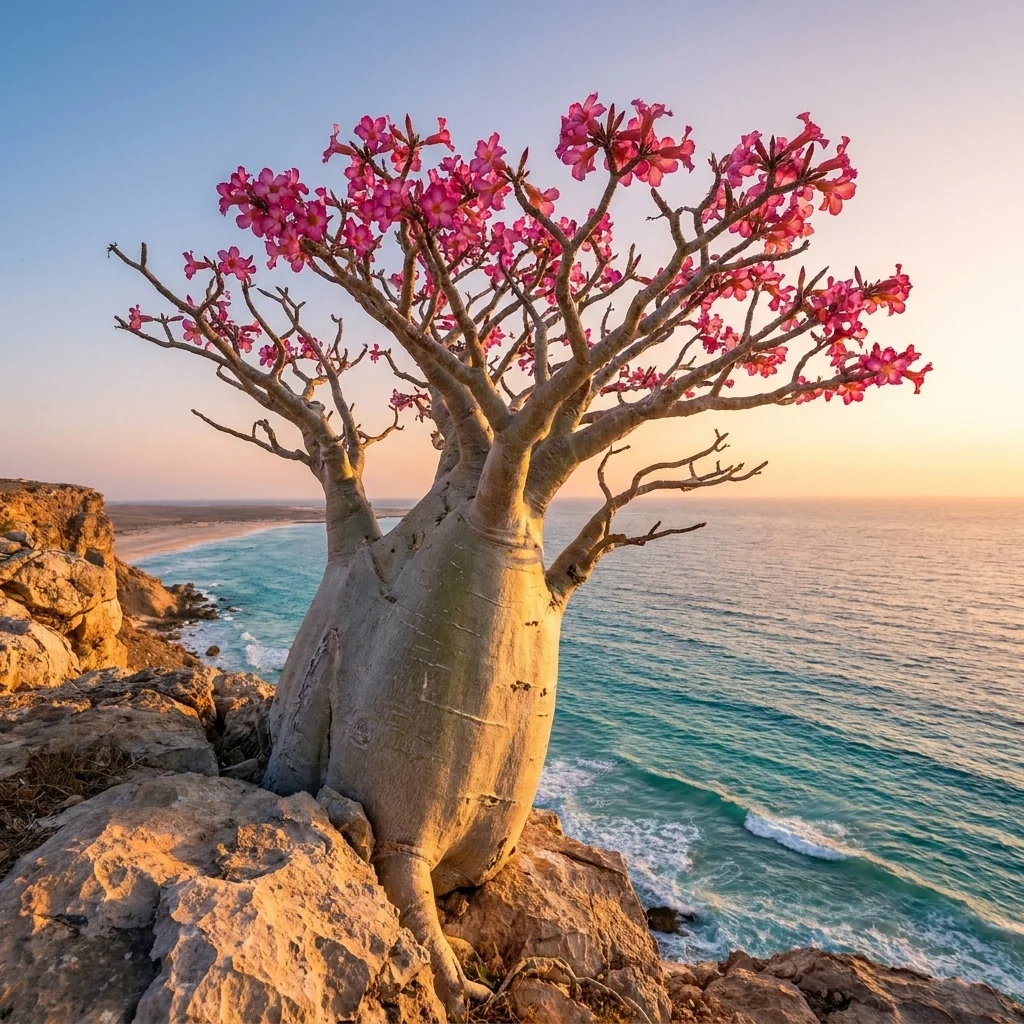
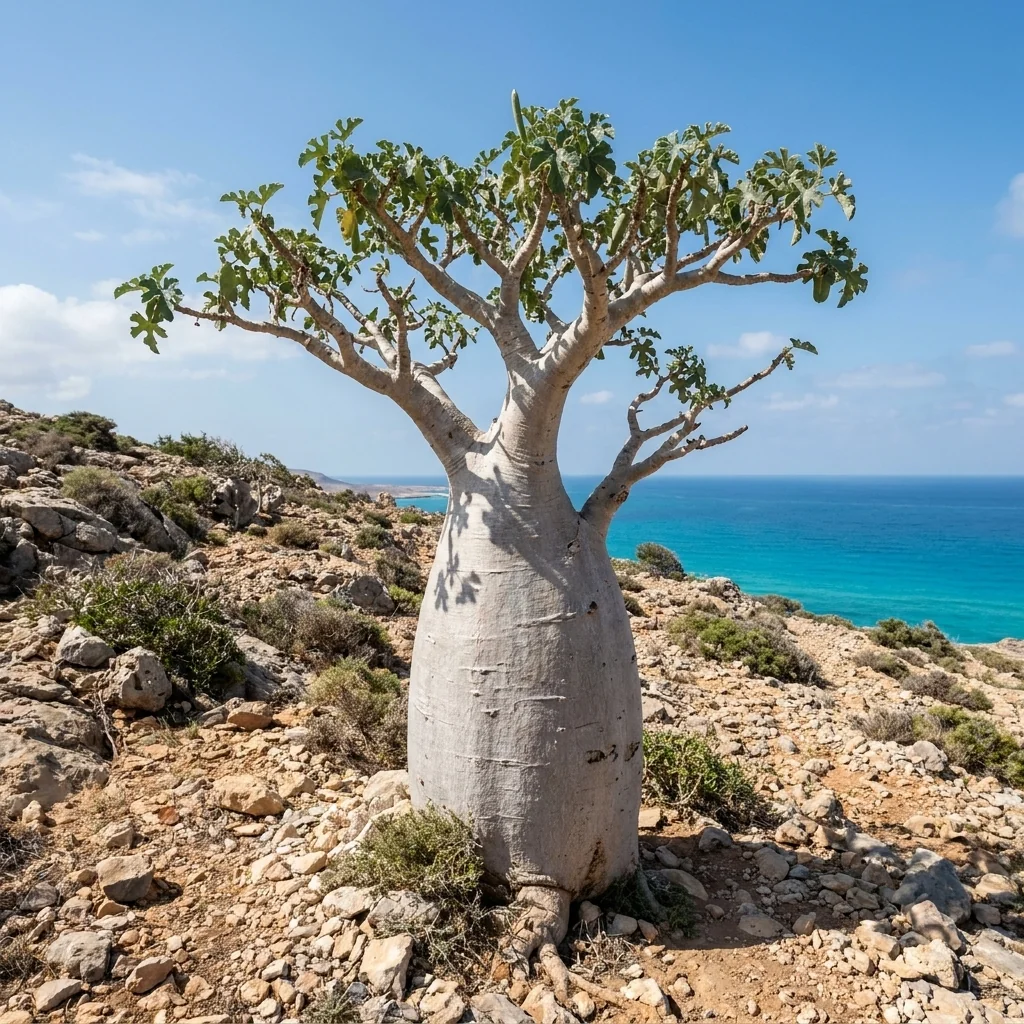
The most dramatically shaped plant on Socotra after the Dragon Blood Tree — a succulent with a massively swollen trunk base (caudex) reaching 4-5 metres tall and up to 2.4 metres in diameter. Smooth, pale grey-green, and water-storing. For a few weeks in February-March, while entirely leafless, it erupts in vivid pink-to-magenta trumpet flowers emerging directly from bare sculptural wood. One of the most photographed plants on Earth and a defining symbol of Socotra's alien landscape. Found island-wide on rocky limestone from sea level to 1,000 m; highest densities at Diksam Plateau and Homhil Protected Area.

Conservation

Not formally assessed at subspecies level

Fun fact

A single mature specimen can hold hundreds of litres of water in its trunk, allowing it to bloom spectacularly during the dry season when most desert plants look dead.

Photography tips

Wide-angle (24-50mm) for environmental portraits showing full caudex form against plateau or sky. Telephoto (70-200mm) for isolating flower clusters. Backlight at golden hour makes the pale trunk glow and pink flowers translucent — shoot with sun behind or to the side. The leafless flowering state (Feb-March) is dramatically more photogenic than the leafy phase. Look for cliff-edge specimens for compression with telephoto.

Submit a photo of Socotra Bottle Tree
Socotra Bunting
Endemicbird

Socotra Bunting

Emberiza socotrana

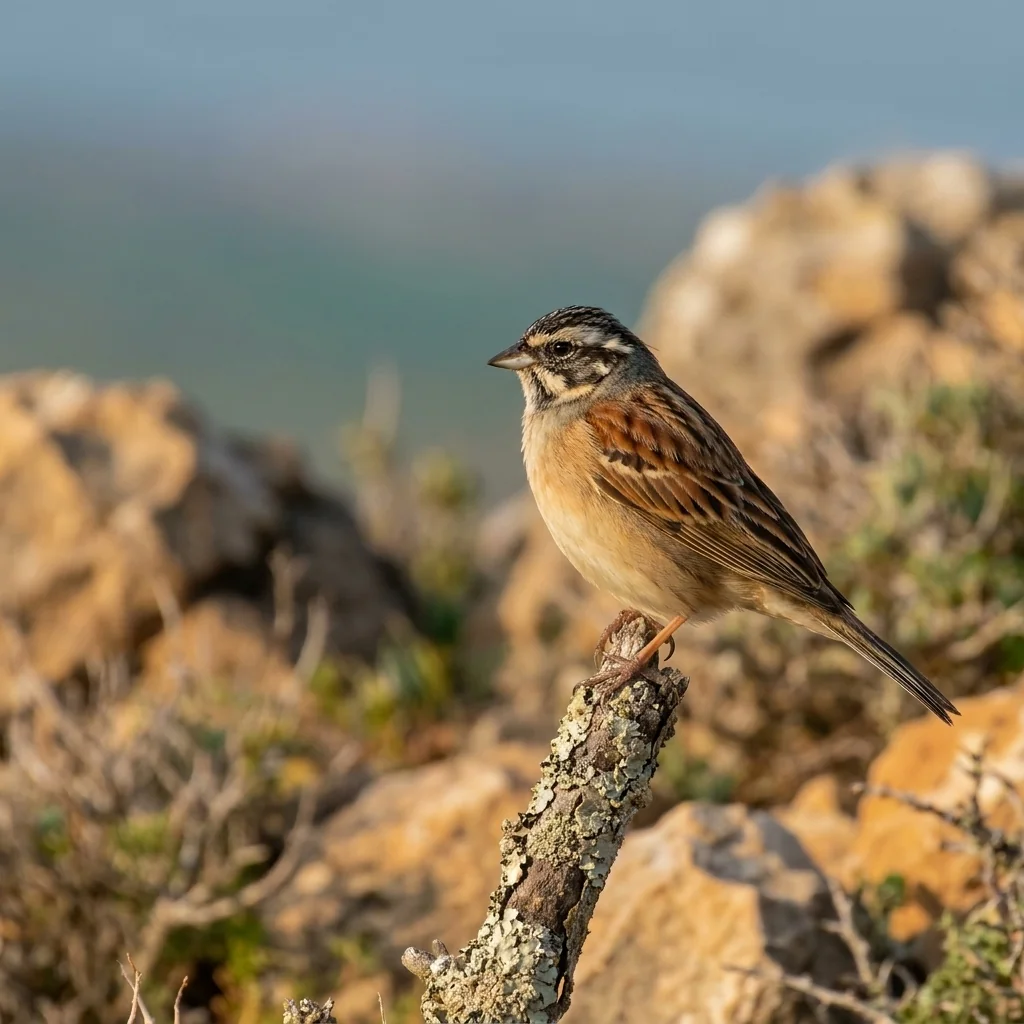
An endemic bunting with an estimated global population of approximately 1,000 pairs — placing it firmly in Endangered territory on the IUCN Red List. The male is distinctive: a chestnut back, pale underparts, and a white-flecked head pattern. The female is streaked brown, less immediately identifiable in the field. It is the most endangered bird endemic to Socotra. Threats include habitat degradation from overgrazing in the highland zones, and — long-term — reduced cloud cover affecting the montane scrub vegetation it depends on for nesting. The population has not been formally surveyed since the early 2010s; actual numbers may be lower. Found in highland scrub and rocky slopes above 500m. Diksam Plateau and Homhil Protected Area are the primary accessible sites. Dawn is the most productive time — the males sing persistently from exposed perches in the early morning. A 400–600mm lens is needed for usable images; the birds are wary and do not tolerate close approach.

Conservation

Endangered (IUCN)

Fun fact

With roughly 1,000 breeding pairs and a range limited to a single island, the Socotra Bunting is one of the rarest birds accessible to independent travelers anywhere in the world — yet most visitors to Diksam Plateau walk past it without knowing it exists. There is no dedicated conservation program for it.

Photography tips

Dawn is the only productive window — males sing persistently from exposed scrub perches in the first hour after sunrise, then fall silent. 400-600mm telephoto. Position on the high side of a slope to shoot across at eye level rather than looking up. The chestnut back is the key field mark to nail in focus; the head pattern requires good light. Wary — approach very slowly and stop frequently. Males flush and resettle; wait in position rather than chasing.

Submit a photo of Socotra Bunting
Socotra Chameleon
Endemicreptile

Socotra Chameleon

Chamaeleo monachus

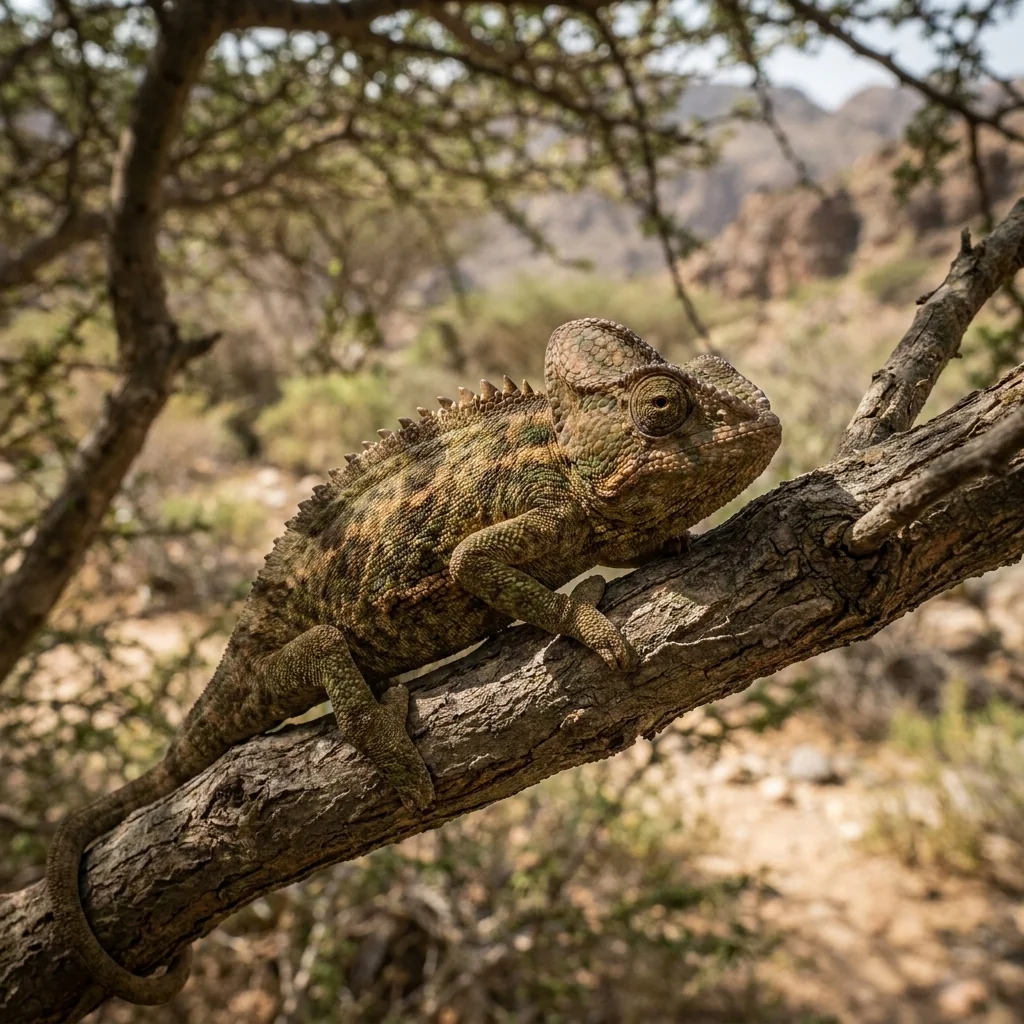
The largest chameleon endemic to Socotra, reaching up to 38.5 cm. Defined by exceptionally large occipital lobes at the rear of the head — among the most pronounced of any chameleon species globally — creating a monk's-hood silhouette that inspired the name monachus (monk). A prominent dorsal crest of conical scales runs from neck to tail. Resting coloration is green, brown, or black; males display light blue markings; gravid females show vivid orange zones. Diurnal and arboreal — spends active hours in shrub and tree canopies up to 6 metres. Mating October-November; egg-laying December; hatching April-May. Clutch size 32-52 eggs — among the largest of any chameleon.

Conservation

Near Threatened (IUCN 2021)

Fun fact

Socotra's chameleons have been legally exported only 3 times in recorded history — making wild observation the only real way to ever see one.

Photography tips

100mm macro or 70-200mm with close focusing. Scan slowly along wadi shrub margins at 1-3 m height. Early morning (07:00-10:00) when chameleons bask to warm up — more exposed than later in day. Approach very slowly; any sudden movement triggers immediate retreat. A slightly elevated position looking down into shrubs reveals them more easily than eye-level. Diffused light or flash-fill useful in deep wadi shade.

Submit a photo of Socotra Chameleon
Socotra Cisticola
Endemicbird

Socotra Cisticola

Cisticola haesitatus

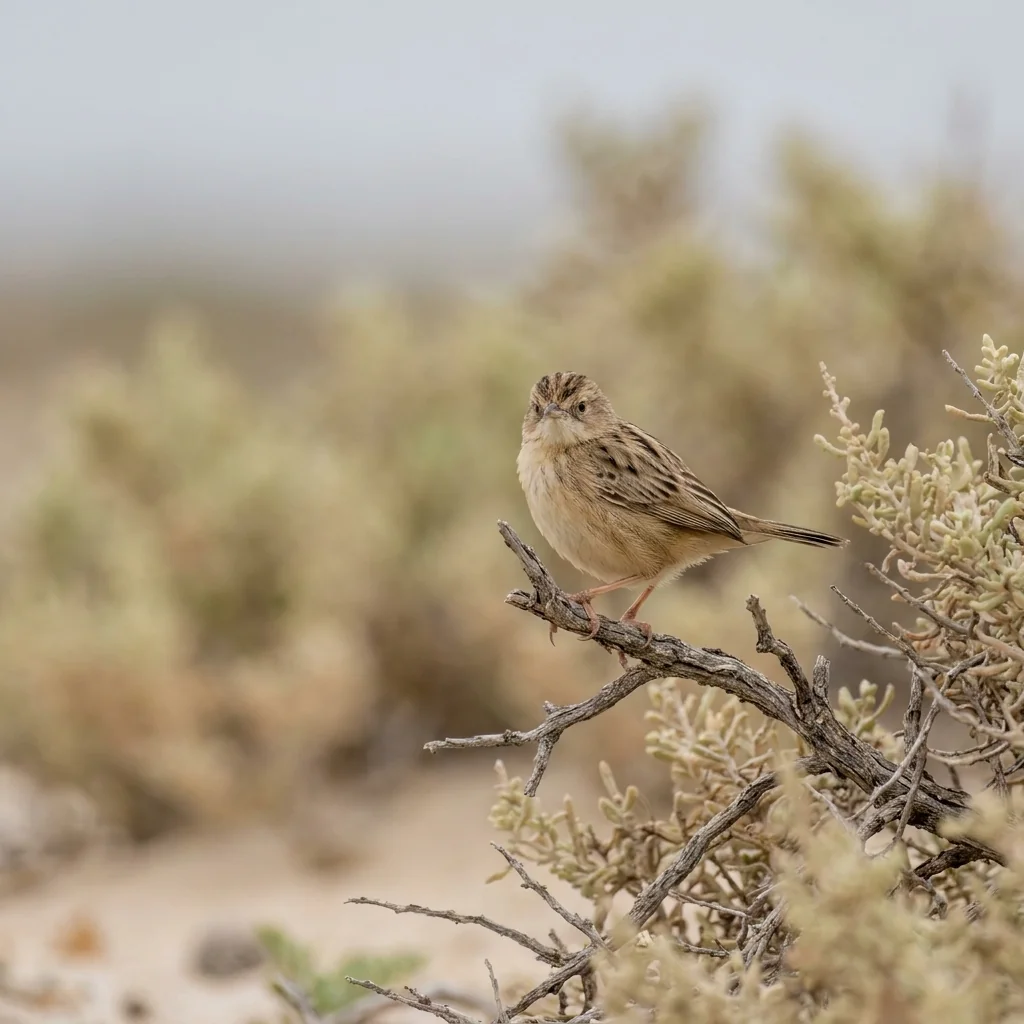
A small (11-12 cm), cryptic warbler endemic to Socotra with streaked brown-buff plumage — entirely camouflaged against the coastal dwarf-shrubland it specialises in. Its entire global habitat is estimated at under 100 km². Restricted to dense coastal lowland shrubland below 100 m, plus a second population at Ma'lih Plateau (~650 m) discovered since 2013. Skulks low in vegetation; one of the harder endemic birds to photograph. Found on the northern coastal plain between Hadibo and Qalansiyah. Remained unknown to science until 1881 — even today, no formal population census exists.

Conservation

Near Threatened (December 2022 reassessment)

Fun fact

The Socotra Cisticola's entire global range fits within an area smaller than the city of Paris — yet it appears to have maintained a stable population across millennia in that tiny footprint.

Photography tips

300-500mm telephoto. Extreme patience required. Walk slowly through dense low coastal scrub and listen for the high-pitched rattling call. Males briefly perch in the open when singing — that is the window. Approach very slowly; the bird flushes into nearby low cover rather than departing entirely. Crouch or lie prone at vegetation edge. Overcast diffused light better than harsh midday sun for the muted brown tones.

Submit a photo of Socotra Cisticola
Socotra Frankincense Tree
Endemictree

Socotra Frankincense Tree

Boswellia elongata

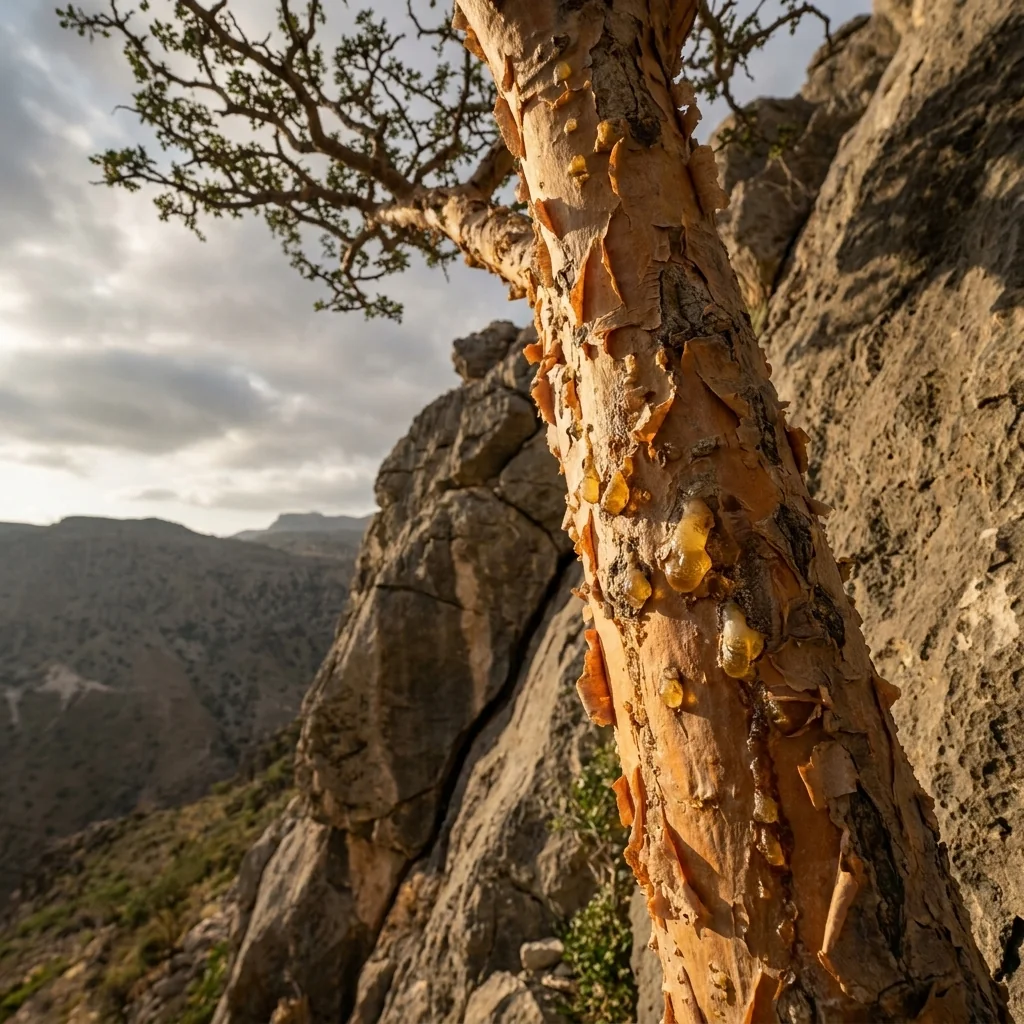
One of 11 frankincense tree species endemic to Socotra and the most accessible — forming a rare intact Boswellia woodland at Homhil Protected Area. A small to medium tree (4-8 m) with distinctively papery, peeling orange-buff bark and amber-yellow frankincense resin that oozes naturally from the trunk without bark damage — unique among Boswellia species globally. Among the finest frankincense on Earth. Traded from Socotra for 5,000+ years. Found at Homhil Protected Area on the standard trekking route (500-800 m elevation).

Conservation

Endangered (IUCN uplisted from Vulnerable in 2025, following Maděra et al

Fun fact

Socotra hosts 11 of the world's 24 known frankincense tree species — nearly half of all frankincense diversity on Earth concentrated on a single island you could drive across in a few hours.

Photography tips

Wide-angle (24-70mm) for environmental shots placing trees within limestone cliff landscapes. Close-up (70-200mm) for peeling bark texture and amber resin nodules — the resin detail is one of the most commercially striking close-up subjects on the island. Backlight through the open crown shows leaf translucency when leaves are present. Morning light hits pale bark at a low angle revealing the peeling texture. Ask local guides about current resin flow — fresh exudate photographs differently from hardened nodules.

Submit a photo of Socotra Frankincense Tree
Socotra Golden-winged Grosbeak
Endemicbird

Socotra Golden-winged Grosbeak

Rhynchostruthus socotranus

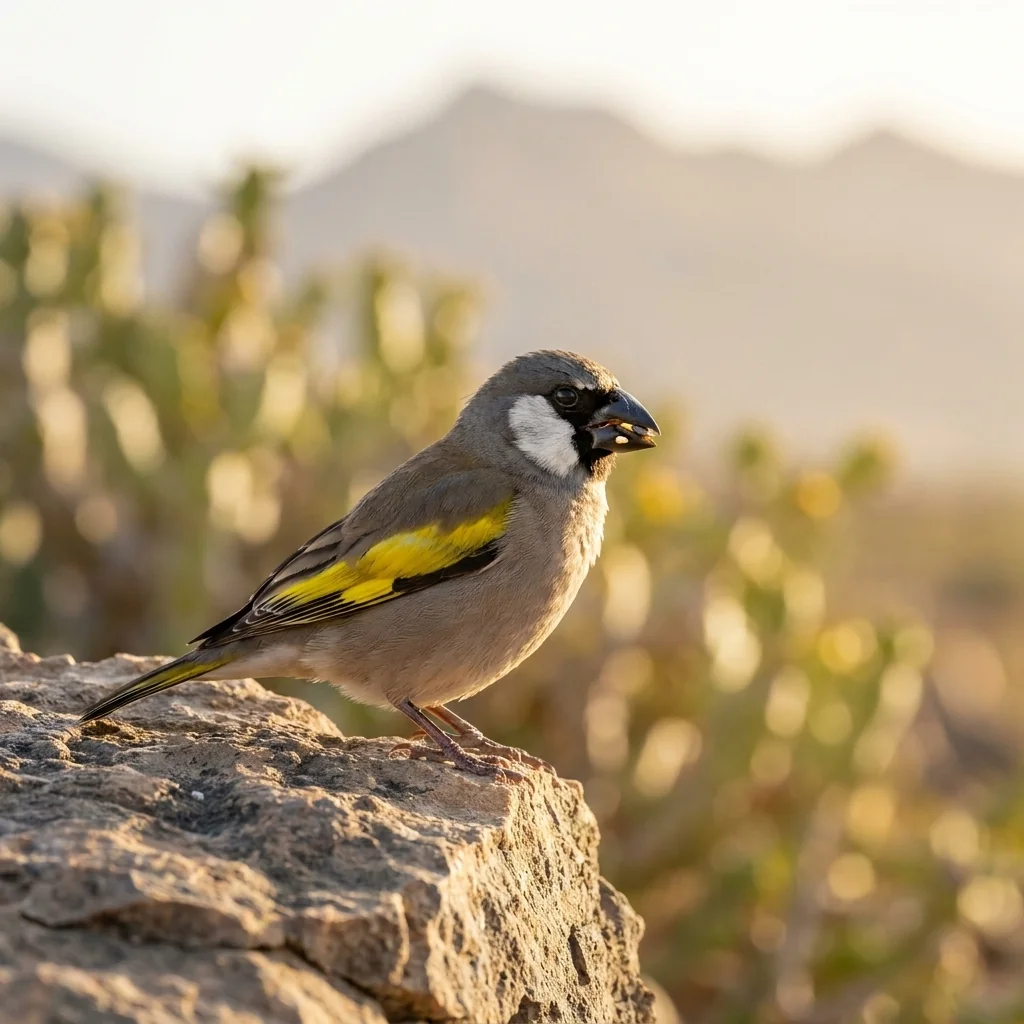
A stocky, 15-16 cm finch with a powerful black bill and one of the most visually striking field marks of any Socotra endemic: brilliant chrome-yellow patches on wings and tail that flash unmistakably in flight. Males are grey-brown overall with a dark head, black facial mask, and large white cheek patches. Females are slightly duller. The most widespread endemic bird, covering ~70% of the island at 200-800 m in arid Euphorbia, Acacia, and Juniper scrubland. Commonly seen in groups of up to 30. Reliable sites: Diksam Plateau, Wadi Ayhaft upper reaches, rocky slopes around Hadibo.

Conservation

Least Concern (2024 IUCN)

Fun fact

Once considered the same species as the Arabian and Somali golden-winged grosbeaks — Socotra's isolation drove enough divergence that it is now its own full species, a textbook case of island speciation captured in a single striking bird.

Photography tips

Listen for contact calls first — birds are often heard before seen. 300-500mm telephoto. Position in juniper or Euphorbia woodland and wait for perch landings. The yellow wing patches are only fully visible in flight or when wings are spread — anticipate take-off moments with burst mode. Males on exposed rocky perches catch backlit golden hour well.

Submit a photo of Socotra Golden-winged Grosbeak
Socotra Starling
Endemicbird

Socotra Starling

Onychognathus frater

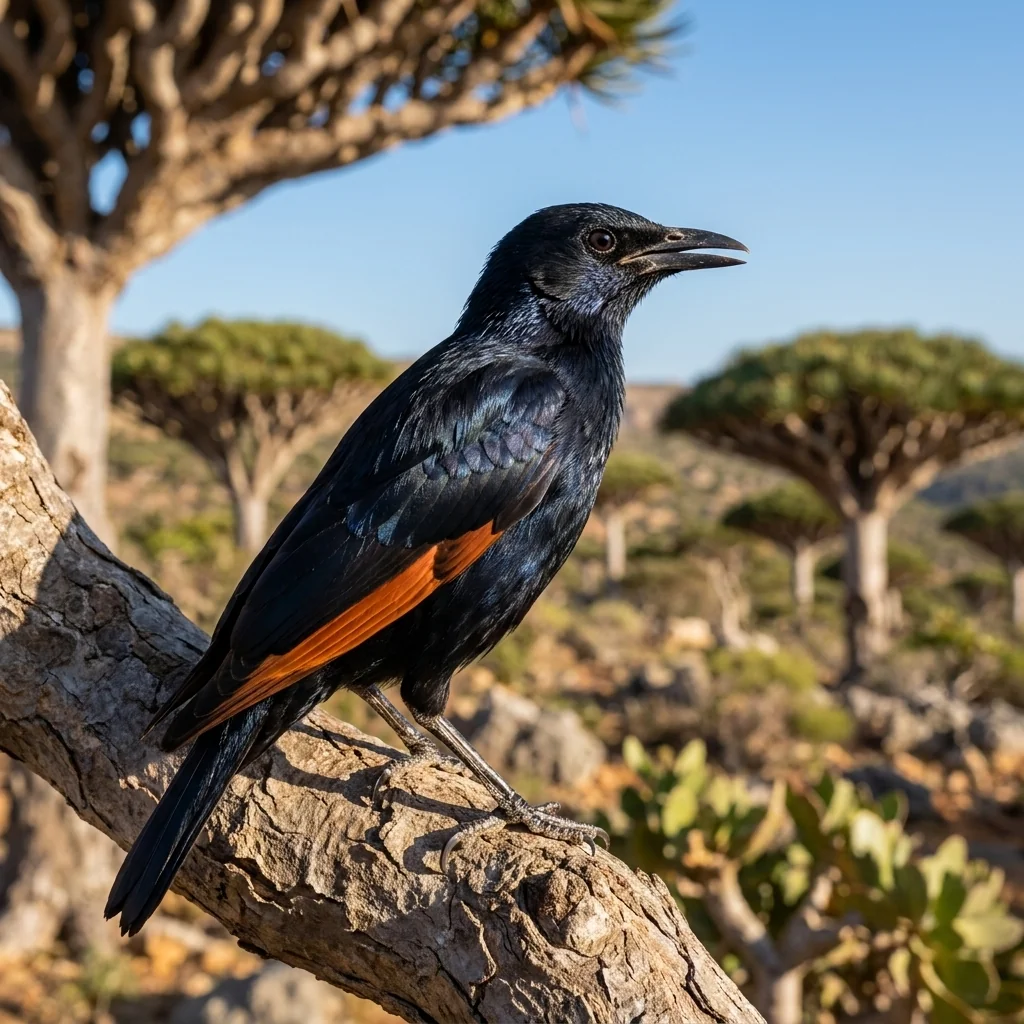
A robust, 25 cm starling with glossy black iridescent plumage and a defining field mark: bright rufous-chestnut primary wing feathers forming a vivid orange-red panel in flight. Highly social and commonly encountered in flocks. Has an intimate ecological relationship with the Dragon Blood Tree — it nests exclusively in its hollow branches, feeds on its berries, and disperses its seeds, making it critical to Dragon Blood Tree reproduction. Found island-wide from sea level to 1,500 m; most reliably seen at Diksam Plateau Dragon Blood Tree groves and near Hadibo. Probably the most frequently encountered endemic bird on a typical Socotra tour.

Conservation

Least Concern (2024)

Fun fact

The Socotra Starling nests exclusively in Dragon Blood Tree hollow branches and disperses its seeds — making it one of the few bird species entirely dependent on a single tree species for nest sites. Where Dragon Blood Tree regeneration fails, the starling eventually follows.

Photography tips

200-400mm for perched portraits; 400-600mm for flight shots capturing the rufous wing flash. Iridescent sheen only visible in direct or angled sunlight — flat overcast makes the bird look flat black. Position near Dragon Blood Tree grove edges for movement shots. The bird is not shy near settlements and tolerates close approach.

Submit a photo of Socotra Starling
Socotra Sunbird
Endemicbird

Socotra Sunbird

Chalcomitra balfouri

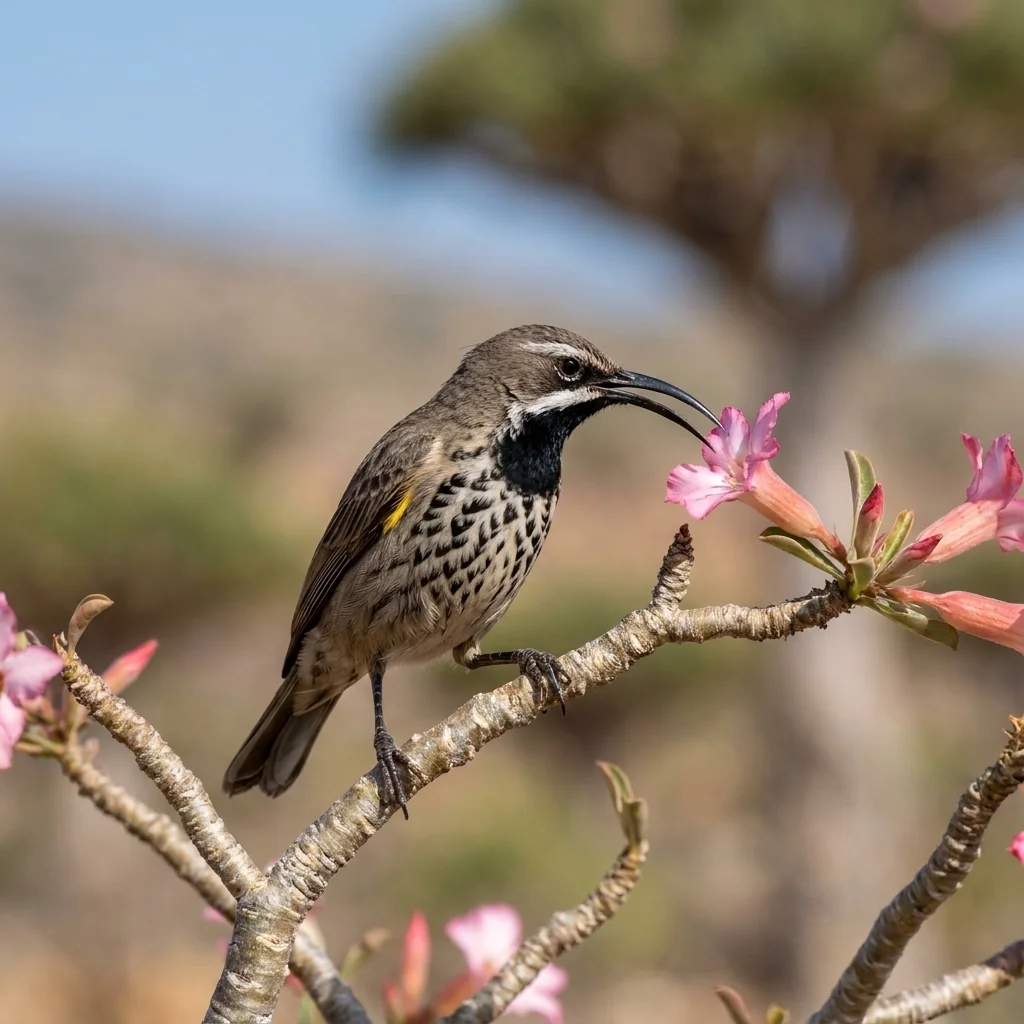
A small (12-13 cm) nectar-feeding bird endemic to Socotra and one of the island's primary pollinators. Males look nearly identical to females — brown-grey upperparts with bold black scaling, a distinctive black throat patch, white whisker stripes, and a small yellow shoulder tuft. The long, decurved bill is adapted for probing tubular flowers of endemic plants including Adenium and Boswellia. Widespread across the island wherever shrubby vegetation with flowering plants exists; most reliably found at Homhil Protected Area and Wadi Ayhaft. Population suspected declining due to overgrazing and habitat loss.

Conservation

Least Concern (BirdLife 2025)

Fun fact

Unlike most sunbird species where males are brilliantly iridescent, the Socotra Sunbird's male looks nearly identical to the female — an unusual evolutionary reversal, likely shaped by millions of years of island isolation.

Photography tips

Position near a flowering Adenium or Boswellia and wait — sunbirds return repeatedly to the same blooms. 200-400mm telephoto. Midmorning (07:00-09:00) best. The black throat patch and white whiskers are the key ID features. The yellow shoulder tuft is only visible when the bird is relaxed — allow settle time. Hover behavior at flowers gives sharp wing-spread shots.

Submit a photo of Socotra Sunbird
Socotran Blue Tarantula
Endemicfauna

Socotran Blue Tarantula

Monocentropus balfouri

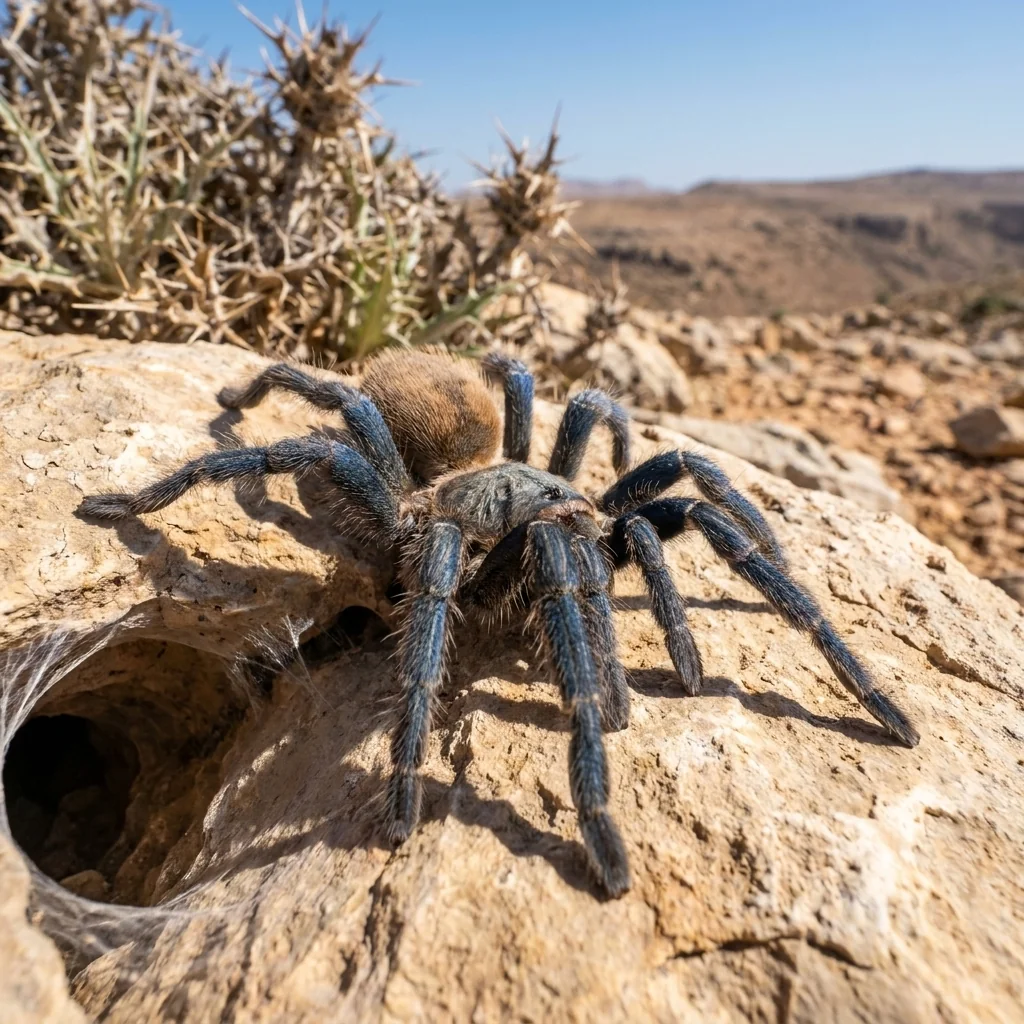
One of the most visually striking spiders in the world and the only blue tarantula found outside of southeast Asia. Adult males display vivid blue-grey legs and a contrasting tan abdomen; females are larger, reaching 12–15cm leg span, and are a more muted brown. Both sexes exhibit unusual cooperative behaviour — the species is one of only a handful of tarantulas that tolerate communal living, with multiple females and juveniles sharing a burrow system. The venom has not been formally documented in humans. Bites are not considered dangerous based on all available evidence, but no clinical study exists. Handle only with guide supervision. Found across the highland and plateau zones, particularly in rocky areas with loose soil. Diksam Plateau and Homhil Protected Area are the most reliable sighting locations. Nocturnal — easiest to spot by torchlight near burrow entrances after dark. They are endemic and strictly protected; do not collect, disturb burrows, or remove individuals. The species commands significant value in the exotic pet trade, which has driven illegal collection; do not photograph in ways that reveal location specifics.

Conservation

Not assessed on the IUCN Red List

Fun fact

One of only a handful of tarantula species in the world that lives communally — multiple females and juveniles share burrow systems without aggression. Most tarantulas are solitary and fiercely territorial; Socotra's isolation appears to have selected for cooperative living as a strategy against the island's harsh seasonal conditions.

Photography tips

Nocturnal — find by torchlight scanning near burrow entrances after dark. Ask your guide to locate active burrows before nightfall. A 100mm macro or 70-200mm with macro extension is ideal. Red light preserves your night vision and causes less disturbance than white. The vivid blue colour reproduces best with a single off-axis softbox flash rather than direct frontal flash. Do not share images that reveal specific burrow GPS locations — illegal collectors actively mine social media for exactly this information.

Submit a photo of Socotran Blue Tarantula