
Shoab Beach
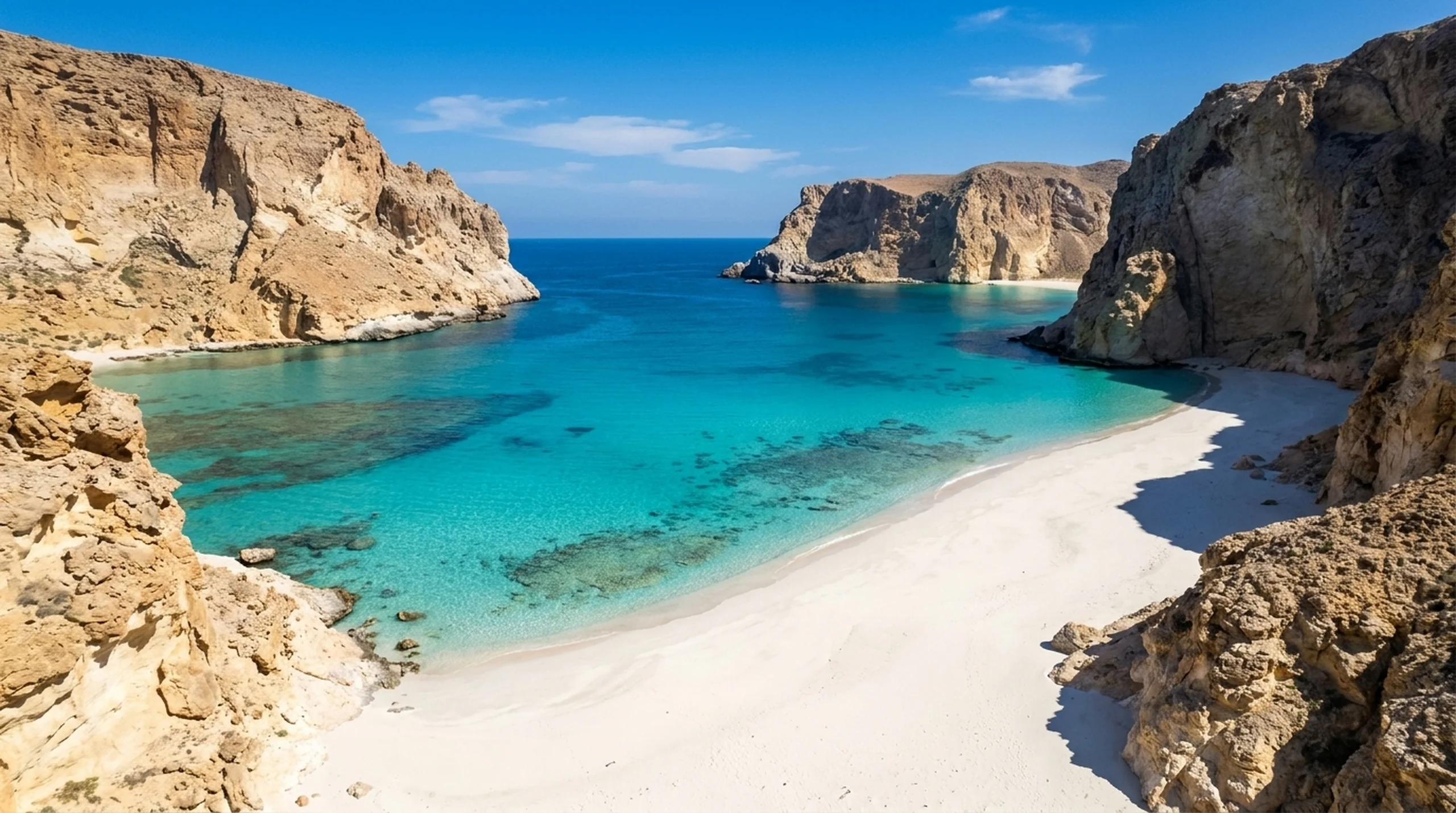
A double lagoon accessible only by a one-hour boat ride from Qalansiyah. The water shifts from deep blue to iridescent aquamarine between two natural rock barriers, creating a composition that looks like CGI. Dolphins are common on the crossing; whale sharks appear seasonally; bioluminescent plankton lights up the water at night.
01
Why it's special
The boat-only access means almost no day visitors. You'll have one of the most surreal beach landscapes on Earth largely to yourself. The double lagoon effect — two distinct water colours separated by a sandbar — is unique to Shoab.
02
What to expect
A double lagoon accessible only by a one-hour boat ride from Qalansiyah. The water shifts from deep blue to iridescent aquamarine between two natural rock barriers, creating a composition that looks like CGI. Dolphins are common on the crossing; whale sharks appear seasonally; bioluminescent plankton lights up the water at night.
03
Reality check
Accessible only by boat — your guide arranges this. Budget an extra half-day and add it explicitly when booking your itinerary.
Photography Intelligence
Shoot it right.
The case for Shoab Beach
Sunset works better here than sunrise · aerial work is genuinely worth it · midday light is harsh and rarely worth prioritising.
Best time to shoot
Morning for water colour; sunset for the double lagoon glow
Sunrise or sunset?
Water at its most vivid. Walk the sandbar between the two lagoon bodies for the split-colour composition. · The inner lagoon catches warm light from the west. The outer section stays cool blue. The colour contrast doubles.
Light direction notes
Coastal orientation matters — check whether the shoreline faces east (sunrise) or west (sunset). Side-light from a low sun shapes the water best.
Drone timing
Drone is highly effective here for the double lagoon colour contrast. Calm winds in the morning. Altitude gives you both water bodies in a single frame — the composition doesn't work from ground level.
Conditions to avoid
Midday sun flattens contrast and burns out highlights; breezier afternoons can unsettle a tripod; outside oct, nov, dec, jan, feb, mar, conditions become unreliable.
Composition tips
Shoot from the sandbar dividing the two lagoon sections — you get both colour gradients in one frame with the sea beyond. For dolphin shots on the boat crossing, keep the camera on continuous burst from the bow.
Lens suggestions
Wide lens recommended. Open landscapes reward 16–35mm to capture sky-to-ground sweep.
Reality check
The double lagoon — two separate bodies of water with different depths and therefore different blues — is the defining image. Dolphin sightings are near-certain on the boat crossing. Whale sharks visit October-December. Bioluminescent plankton active on calm dark nights.
Coming soon·Sun-path overlay with date-aware azimuth and elevation per location.
FAQ
About Shoab Beach
What is Shoab Beach known for?+
What time of day is best at Shoab Beach?+
What months can you visit Shoab Beach?+
Can you swim at Shoab Beach?+
Can you fly a drone at Shoab Beach?+
Do you need a guide to visit Shoab Beach?+
Is Shoab Beach safe to visit?+
What should you know before visiting Shoab Beach?+
Nearby & similar
Related places
Keep reading
Related guides
Is Socotra safe to visit?
Socotra is not mainland Yemen, and violence has not reached the island. But in January 2026 armed conflict on the mainland grounded flights and stranded hundreds of tourists for days. That is the real risk, and it is not weather.
Read
The best time to visit Socotra
October through April is the only realistic window. From May to September the Khareef monsoon brings sustained 50-knot winds and most operators shut down. February and April are the two best months.
Read
Cost of a Socotra trip
Packages start around $1,300 per person for eight days, plus roughly $950 to $980 for the weekly Jeddah charter. A realistic all-in figure is $3,000 to $4,000 before international flights.
Read
Have a photo of Shoab Beach?
Submit it to the gallery — we credit you with a link to your site and Instagram.