
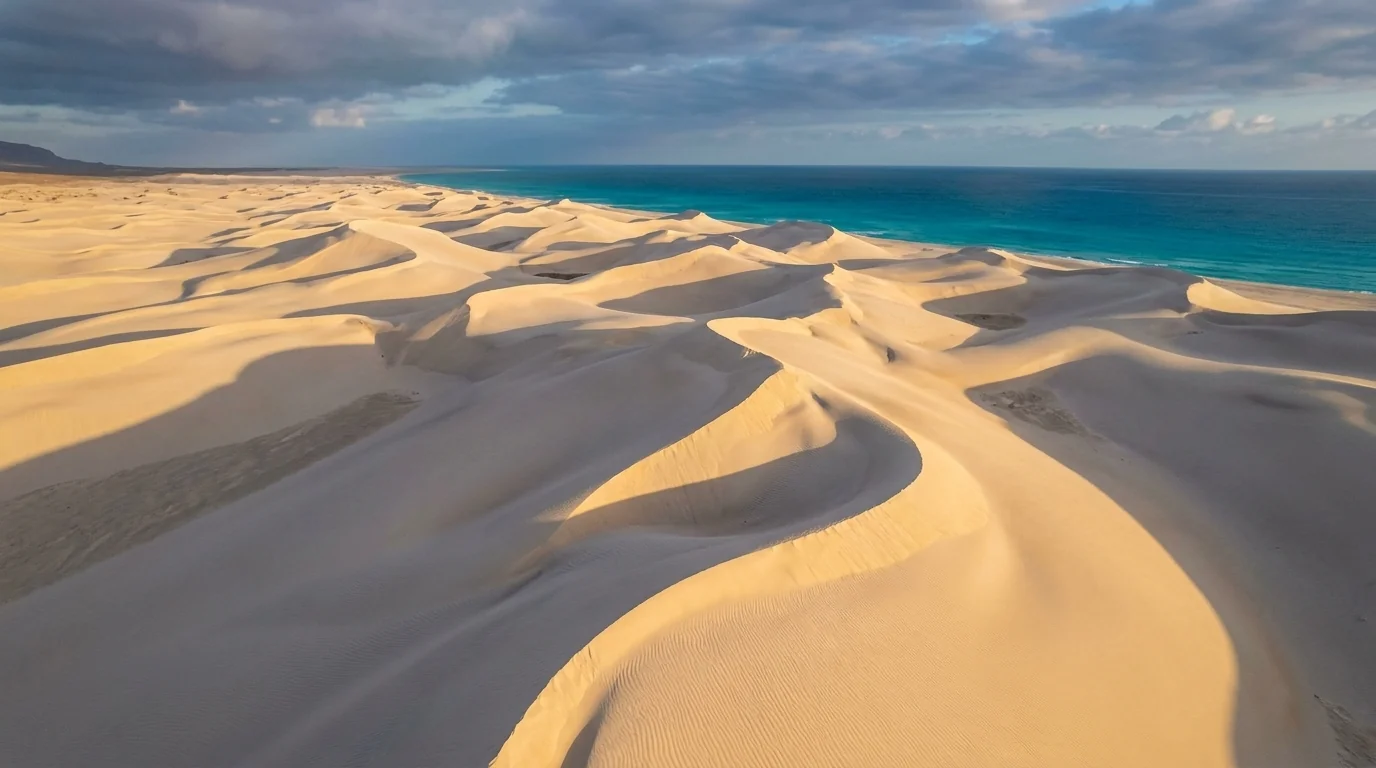
Steroh Dunes
A remote coastal settlement on the far southern shore in the Noged district, with near-white dunes directly adjacent to the Indian Ocean. Part of the expansive Noged dune-and-beach system, with the Noged Plateau providing a mountainous backdrop. Very few tourists reach this location.
01
Why it's special
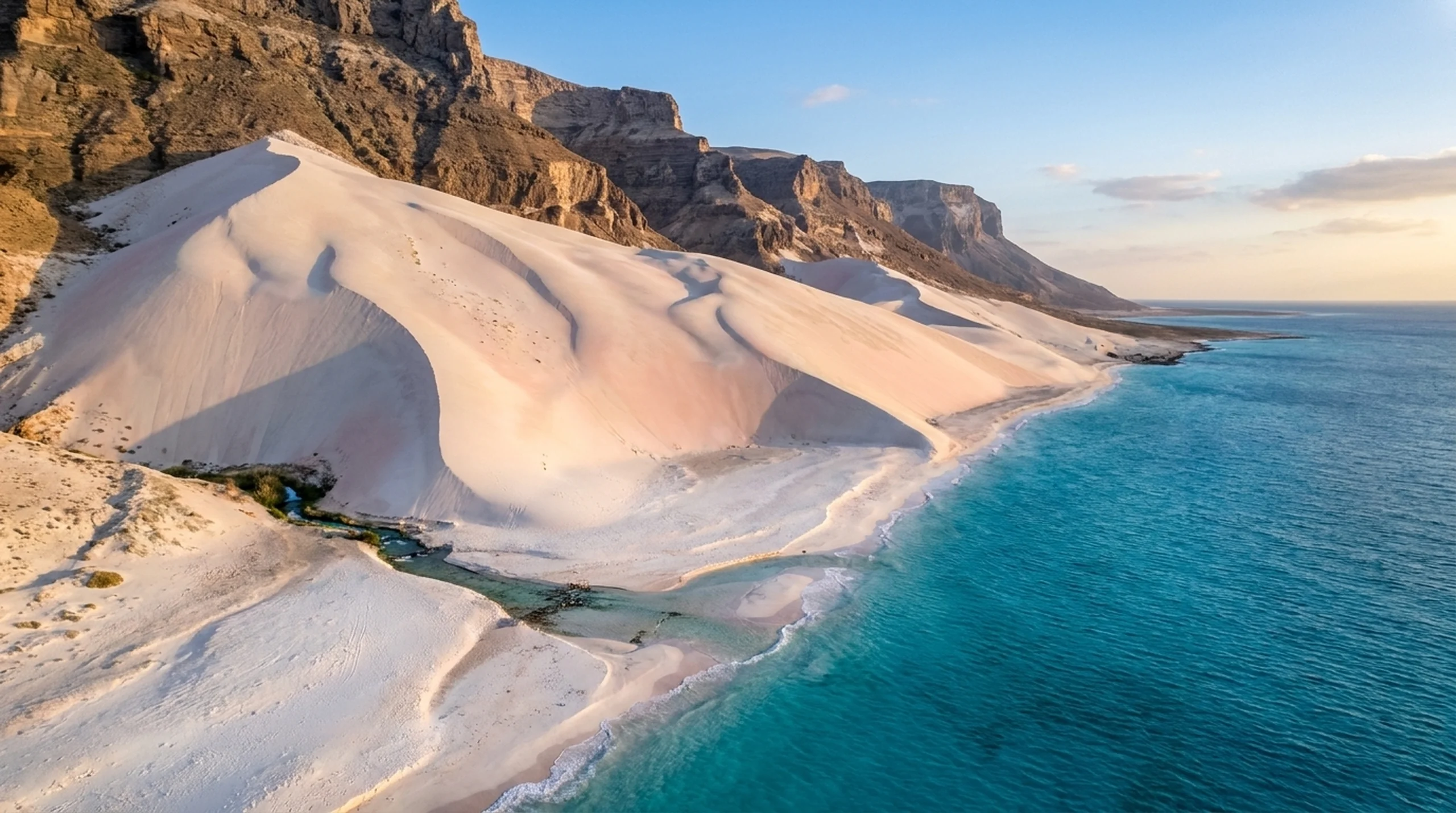
Unlike most desert dune systems, these are almost completely white — a unique colour palette when framed against the turquoise Indian Ocean. Sea and dune are within 50 metres of each other in the same composition.
02
What to expect
A remote coastal settlement on the far southern shore in the Noged district, with near-white dunes directly adjacent to the Indian Ocean. Part of the expansive Noged dune-and-beach system, with the Noged Plateau providing a mountainous backdrop. Very few tourists reach this location.
03
Reality check
Sand intrusion into camera gear is a serious risk on the fully exposed south coast. Bring lens cloths and keep bags sealed. Strong wind most afternoons.
Photography Intelligence
Shoot it right.
The case for Steroh Dunes
Sunset works better here than sunrise · drone is allowed but wind kills most flights past mid-morning · avoid midday when wind and harsh light combine.
Best time to shoot
Sunset — white dunes shift from cream to deep gold to pink in last light
Sunrise or sunset?
Good for clean dune ripple pattern photography in oblique morning light before footprints appear. · Primary session. White dune faces turn warm gold. Ocean horizon as backdrop. Noged Plateau silhouette behind.
Light direction notes
South-facing dune front catches the setting sun directly. Last light falls on the ocean-facing slope — ideal for the dune-to-sea composition.
Drone timing
Open dune field with clear airspace. Fly at sunset along the dune ridges for the white dune meets Indian Ocean composition from above. The isolated south coast setting reads clearly from altitude.
Conditions to avoid
Midday sun flattens contrast and burns out highlights; strong afternoon wind disrupts long exposures and grounds drones; outside oct, nov, dec, jan, feb, mar, apr, conditions become unreliable.
Composition tips
Dune crest with the Indian Ocean behind at sunset: the defining shot here. Footprint-free dune faces reward an early arrival before other visitors. Noged Plateau visible as backdrop on clear days adds compositional depth.
Lens suggestions
Wide lens recommended. Open landscapes reward 16–35mm to capture sky-to-ground sweep.
Reality check
Unlike most desert dune systems, these are near-white — the colour shift at sunset is subtle and beautiful rather than vivid orange. Sea and dune in the same frame within 50 metres. Strong sand-in-gear risk on the fully exposed south coast; seal all bags between shots.
Coming soon·Sun-path overlay with date-aware azimuth and elevation per location.
FAQ
About Steroh Dunes
What is Steroh Dunes known for?+
What time of day is best at Steroh Dunes?+
What months can you visit Steroh Dunes?+
Can you fly a drone at Steroh Dunes?+
Do you need a guide to visit Steroh Dunes?+
Is Steroh Dunes safe to visit?+
What should you know before visiting Steroh Dunes?+
Nearby & similar
Related places
Keep reading
Related guides
Is Socotra safe to visit?
Socotra is not mainland Yemen, and violence has not reached the island. But in January 2026 armed conflict on the mainland grounded flights and stranded hundreds of tourists for days. That is the real risk, and it is not weather.
Read
The best time to visit Socotra
October through April is the only realistic window. From May to September the Khareef monsoon brings sustained 50-knot winds and most operators shut down. February and April are the two best months.
Read
Cost of a Socotra trip
Packages start around $1,300 per person for eight days, plus roughly $950 to $980 for the weekly Jeddah charter. A realistic all-in figure is $3,000 to $4,000 before international flights.
Read
Have a photo of Steroh Dunes?
Submit it to the gallery — we credit you with a link to your site and Instagram.