
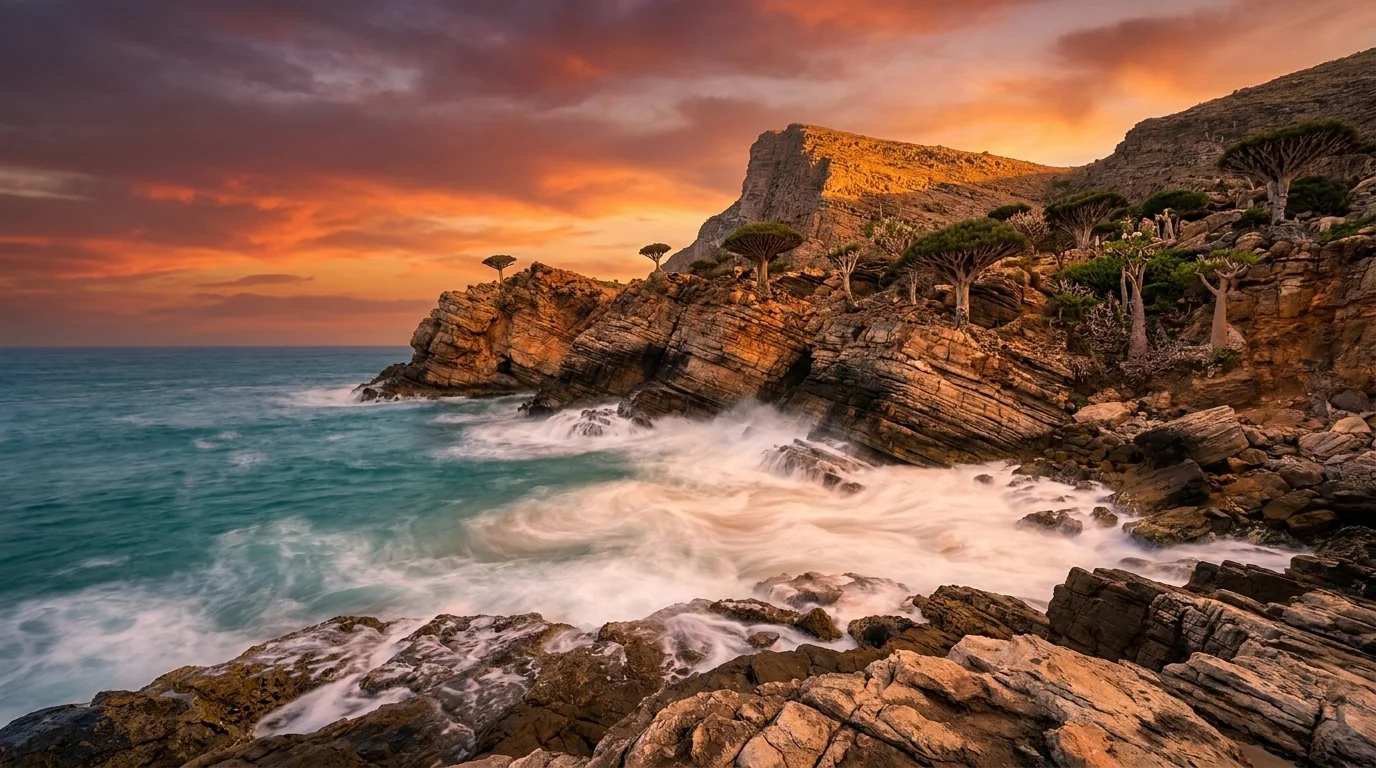
Rosh Cape
A jagged northeastern cape within the Rosh Marine Protected Area, featuring accessible sea caves, blowholes with dramatic spray, and nearshore marine life. Pairs with Ras Erissel as an eastern-tip photography itinerary offering different character — cave access versus open headland.
01
Why it's special
The blowhole spray timed against wave surges gives high-energy seascape shots that are difficult to find elsewhere on the island. Endemic coastal plants on rocky shores offer macro subjects.
02
What to expect
A jagged northeastern cape within the Rosh Marine Protected Area, featuring accessible sea caves, blowholes with dramatic spray, and nearshore marine life. Pairs with Ras Erissel as an eastern-tip photography itinerary offering different character — cave access versus open headland.
03
Reality check
Fully wind-exposed northeastern position. Coordinate confidence is MEDIUM — confirmed as real MPA but precise cape location unverified. Confirm access with your guide.
Photography Intelligence
Shoot it right.
The case for Rosh Cape
Sunset works better here than sunrise · drone is allowed but wind kills most flights past mid-morning · avoid midday when wind and harsh light combine.
Best time to shoot
Sunset — late light on the jagged headland and blowhole spray
Sunrise or sunset?
Good morning light on the cliff faces. Lower wind than afternoon. · Primary session. Backlit blowhole spray in last light. Warm colour on the headland rock.
Light direction notes
Northeast-facing cape. Sunset light arrives from behind-left — good for backlit spray photography.
Drone timing
Open headland with no obstacles for drone launch. Fly along the cape edge for the jagged coastline aerial. Drone in moderate wind only — this is an exposed northeastern position.
Conditions to avoid
Midday sun flattens contrast and burns out highlights; strong afternoon wind disrupts long exposures and grounds drones; outside oct, nov, dec, jan, feb, mar, apr, conditions become unreliable.
Composition tips
Primary blowhole technique: prefocus on the vent, use burst mode, and select the frame with maximum spray height after the session. Rocky surge channels provide seascape foreground — long exposure for silky water against the static rock texture.
Lens suggestions
Bring a versatile zoom — a 24–105 covers most scenes here.
Reality check
Blowhole timing: large swell sets (every 6-12 waves) produce the most dramatic spray — position with the blowhole between you and the sun for backlit water droplet shots. Endemic coastal plants in rocky fissures provide macro subjects during quiet intervals. Eleonora's falcon transit is possible on autumn migration (Oct-Nov).
Coming soon·Sun-path overlay with date-aware azimuth and elevation per location.
FAQ
About Rosh Cape
What is Rosh Cape known for?+
What time of day is best at Rosh Cape?+
What months can you visit Rosh Cape?+
Can you fly a drone at Rosh Cape?+
Do you need a guide to visit Rosh Cape?+
Is Rosh Cape safe to visit?+
What should you know before visiting Rosh Cape?+
Keep reading
Related guides
Is Socotra safe to visit?
Socotra is not mainland Yemen, and violence has not reached the island. But in January 2026 armed conflict on the mainland grounded flights and stranded hundreds of tourists for days. That is the real risk, and it is not weather.
Read
The best time to visit Socotra
October through April is the only realistic window. From May to September the Khareef monsoon brings sustained 50-knot winds and most operators shut down. February and April are the two best months.
Read
Cost of a Socotra trip
Packages start around $1,300 per person for eight days, plus roughly $950 to $980 for the weekly Jeddah charter. A realistic all-in figure is $3,000 to $4,000 before international flights.
Read
Have a photo of Rosh Cape?
Submit it to the gallery — we credit you with a link to your site and Instagram.