
Nogad Area
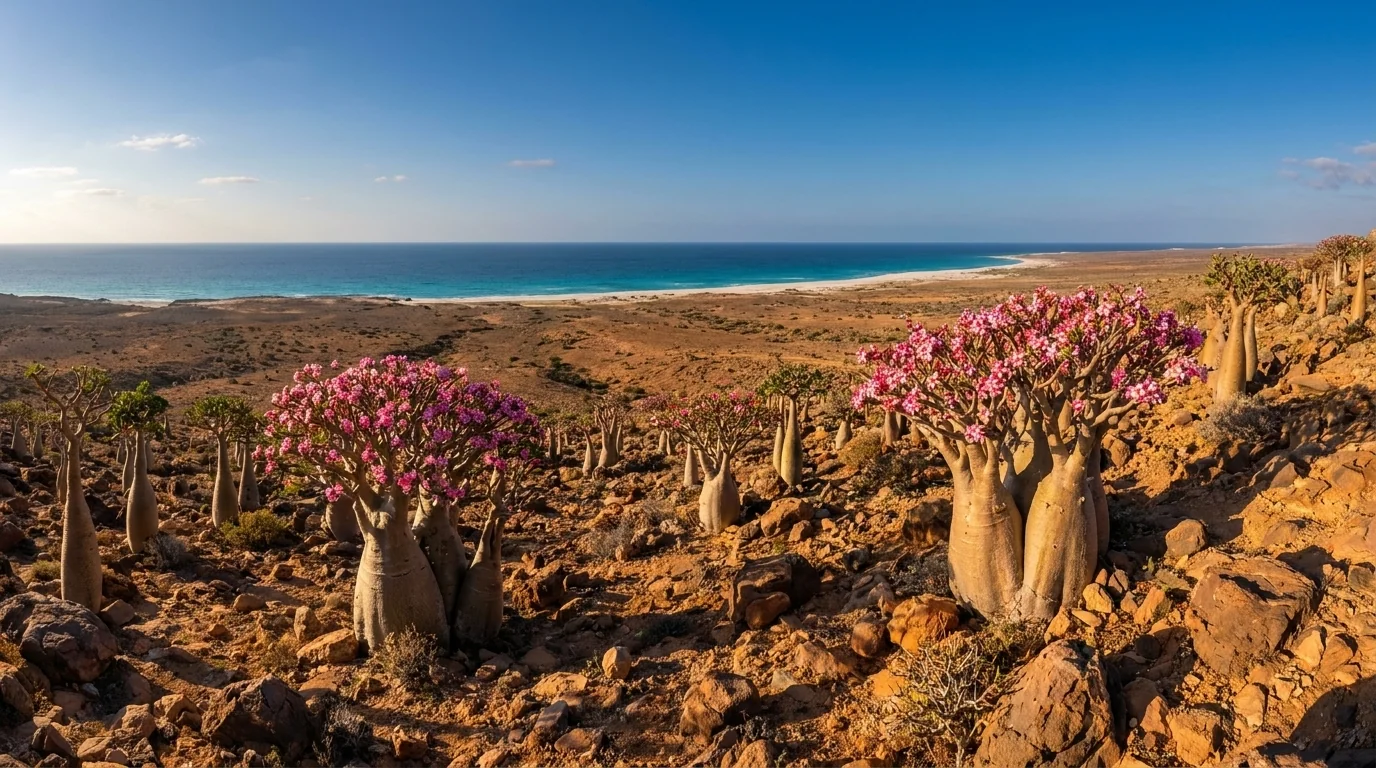
Remote eastern limestone badlands with sparse Dorstenia gigas stands and vast uninterrupted karst terrain. Ultra-isolated location suited to abstract landscape and geological photography. Wind-sculpted pale limestone formations against open sky.
01
Why it's special
The alien emptiness of this karst landscape — minimal vegetation, maximum geological drama — creates a visual language distinct from every other zone. Dorstenia gigas macro details and drone badlands aerials are the primary subjects.
02
What to expect
Remote eastern limestone badlands with sparse Dorstenia gigas stands and vast uninterrupted karst terrain. Ultra-isolated location suited to abstract landscape and geological photography. Wind-sculpted pale limestone formations against open sky.
03
Reality check
Fully exposed eastern plateau position with high wind. Coordinate confidence is MEDIUM. Very remote — only attempt with an experienced guide familiar with this area.
Photography Intelligence
Shoot it right.
The case for Nogad Area
Light depends on season — check the conditions block · drone is allowed but wind kills most flights past mid-morning · avoid midday when wind and harsh light combine.
Best time to shoot
Overcast or morning — harsh midday sun kills the pale limestone detail
Sunrise or sunset?
Best light for the pale limestone — oblique sun creates shadow detail in the karst formations.
Light direction notes
Eastern plateau position. Morning sun rakes across the limestone surface from the east — strongest texture reveal in the first 2 hours after dawn.
Drone timing
Open plateau with no obstacles for drone launch. Abstract badland aerial compositions from 50-100m altitude reveal the karst texture pattern that is impossible to read from ground level.
Conditions to avoid
Midday sun flattens contrast and burns out highlights; strong afternoon wind disrupts long exposures and grounds drones; outside oct, nov, dec, jan, feb, mar, apr, conditions become unreliable.
Composition tips
Dorstenia gigas macro: use extension tubes or a dedicated macro lens for the unusual leaf and flower structure. Drone: fly parallel to the karst surface at low altitude for abstract texture shots. Matte filters reduce atmospheric haze on overcast days and flatten the contrast on clear-sky shots.
Lens suggestions
Bring a versatile zoom — a 24–105 covers most scenes here.
Reality check
Overcast conditions are specifically beneficial here because harsh sun creates blown highlights on the pale limestone. Dorstenia gigas plants are low-growing and widely spaced — approach requires patience and time to find good specimens. The location is very remote; allow extra time for travel and navigation.
Coming soon·Sun-path overlay with date-aware azimuth and elevation per location.
FAQ
About Nogad Area
What is Nogad Area known for?+
What time of day is best at Nogad Area?+
What months can you visit Nogad Area?+
Can you fly a drone at Nogad Area?+
Do you need a guide to visit Nogad Area?+
Is Nogad Area safe to visit?+
What should you know before visiting Nogad Area?+
Keep reading
Related guides
Is Socotra safe to visit?
Socotra is not mainland Yemen, and violence has not reached the island. But in January 2026 armed conflict on the mainland grounded flights and stranded hundreds of tourists for days. That is the real risk, and it is not weather.
Read
The best time to visit Socotra
October through April is the only realistic window. From May to September the Khareef monsoon brings sustained 50-knot winds and most operators shut down. February and April are the two best months.
Read
Cost of a Socotra trip
Packages start around $1,300 per person for eight days, plus roughly $950 to $980 for the weekly Jeddah charter. A realistic all-in figure is $3,000 to $4,000 before international flights.
Read
Have a photo of Nogad Area?
Submit it to the gallery — we credit you with a link to your site and Instagram.