
Wadi Ayhaft
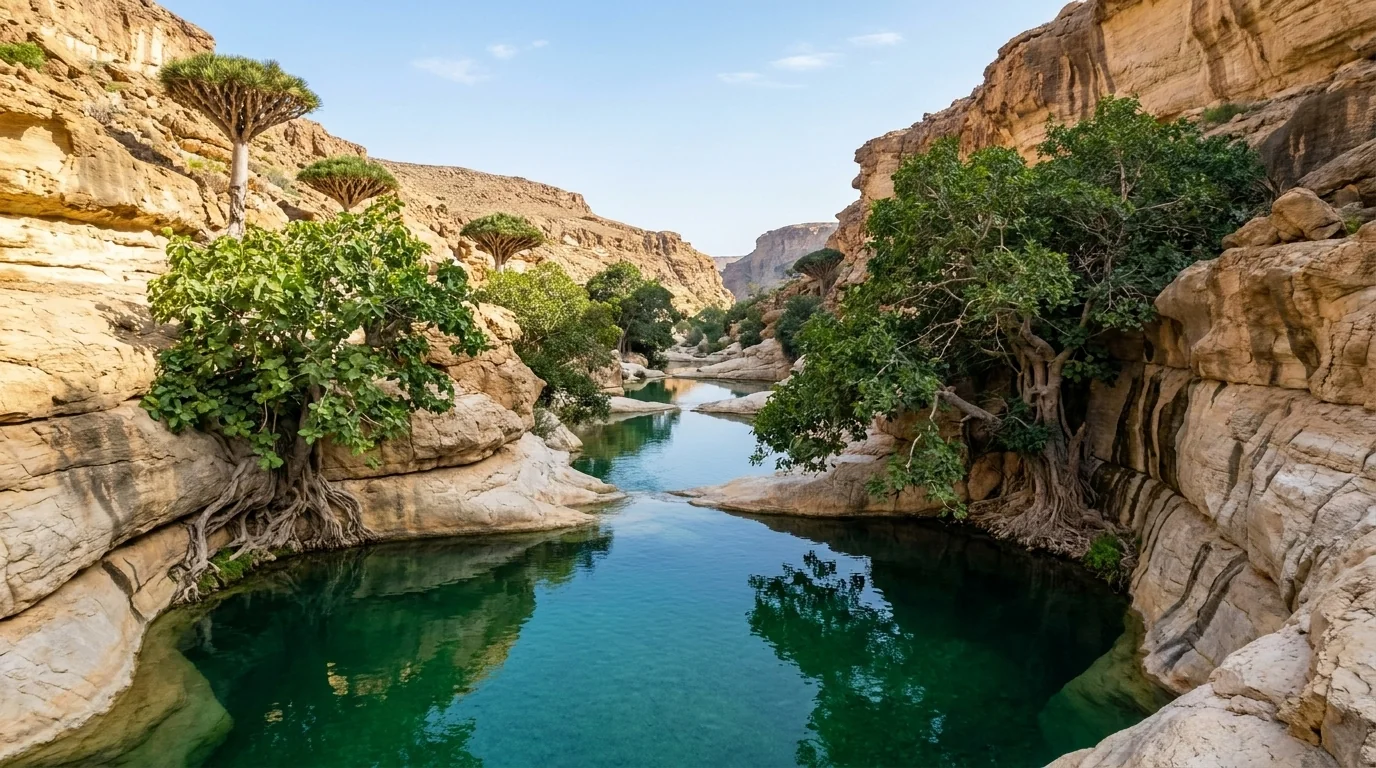
A national park canyon one hour from Hadibo, widely considered the best birding location on Socotra. Large freshwater pools inside the canyon are surrounded by tamarisk, cucumber, and desert rose trees. Verified highest density of endemic plants and birds on the island, including over 1,000 Boswellia ameero frankincense trees per 4 km².
01
Why it's special
Every major Socotra endemic bird — Sunbird, Golden-winged Grosbeak, Starling, Bunting, Buzzard — is reliably found here. The frankincense trees are accessible for close-up resin documentation. This is the most biologically productive canyon on the island for a half-day visit.
02
What to expect
A national park canyon one hour from Hadibo, widely considered the best birding location on Socotra. Large freshwater pools inside the canyon are surrounded by tamarisk, cucumber, and desert rose trees. Verified highest density of endemic plants and birds on the island, including over 1,000 Boswellia ameero frankincense trees per 4 km².
03
Reality check
Accessible by jeep to the canyon entrance; moderate descent to the pool floor. Early morning is essential for birds before heat and wind drive them into cover.
Photography Intelligence
Shoot it right.
The case for Wadi Ayhaft
Best at sunrise — the first warm light is the whole point · aerial work is genuinely worth it.
Best time to shoot
Early morning — birds most active before 09:00, pools coolest
Sunrise or sunset?
Essential. All bird species most active. Pool reflections still calm. Frankincense trees catch warm directional light.
Light direction notes
East-facing canyon entry. Morning light fills the canyon from the east at sunrise — golden light on the tamarisk canopy above the pools.
Drone timing
Open canyon approach before the narrow section allows drone launch. Fly along the canyon rim at dawn for the wadi shape and freshwater pools visible from above. Do not fly inside the narrow inner canyon sections.
Conditions to avoid
Midday sun flattens contrast and burns out highlights; outside oct, nov, dec, jan, feb, mar, apr, conditions become unreliable.
Composition tips
For birds: position near a flowering Adenium or Boswellia and wait — species return to the same blooms repeatedly. Wide-angle for canyon pool compositions from the ridge descent; macro for endemic flowers. Boswellia ameero resin close-ups are scientifically and visually interesting — photograph the resin seep at the base of the bark incision.
Lens suggestions
Bring a versatile zoom — a 24–105 covers most scenes here.
Reality check
The canyon supports the highest bird density of any accessible location on the island. Dawn chorus here includes Sunbird, Grosbeak, Starling, and Bunting simultaneously — exceptional for bird photographers. Boswellia ameero frankincense trees are accessible for close-up resin documentation. Pool-edge macro: endemic flowers attract sunbirds at predictable intervals.
Coming soon·Sun-path overlay with date-aware azimuth and elevation per location.
FAQ
About Wadi Ayhaft
What is Wadi Ayhaft known for?+
What time of day is best at Wadi Ayhaft?+
What months can you visit Wadi Ayhaft?+
Can you fly a drone at Wadi Ayhaft?+
Do you need a guide to visit Wadi Ayhaft?+
Is Wadi Ayhaft safe to visit?+
What should you know before visiting Wadi Ayhaft?+
Nearby & similar
Related places
Keep reading
Related guides
Is Socotra safe to visit?
Socotra is not mainland Yemen, and violence has not reached the island. But in January 2026 armed conflict on the mainland grounded flights and stranded hundreds of tourists for days. That is the real risk, and it is not weather.
Read
The best time to visit Socotra
October through April is the only realistic window. From May to September the Khareef monsoon brings sustained 50-knot winds and most operators shut down. February and April are the two best months.
Read
Cost of a Socotra trip
Packages start around $1,300 per person for eight days, plus roughly $950 to $980 for the weekly Jeddah charter. A realistic all-in figure is $3,000 to $4,000 before international flights.
Read
Have a photo of Wadi Ayhaft?
Submit it to the gallery — we credit you with a link to your site and Instagram.